Every industrial manufacturer in the U.S. right now has some version of the same complaint: not enough qualified candidates, too many roles open too long, the same handful of experienced workers getting recruited by every competitor in the region. The projected shortfall is 2.1 million manufacturing workers by 2030. Facilities are running on overtime. Supervisors are managing roles they shouldn’t have to cover because the headcount isn’t there.
And then those same employers go back to doing exactly what they’ve always done — sourcing from the same candidate pools, writing the same job descriptions, hiring from the same demographic — while 47% of the U.S. workforce sits largely untapped in their sector.
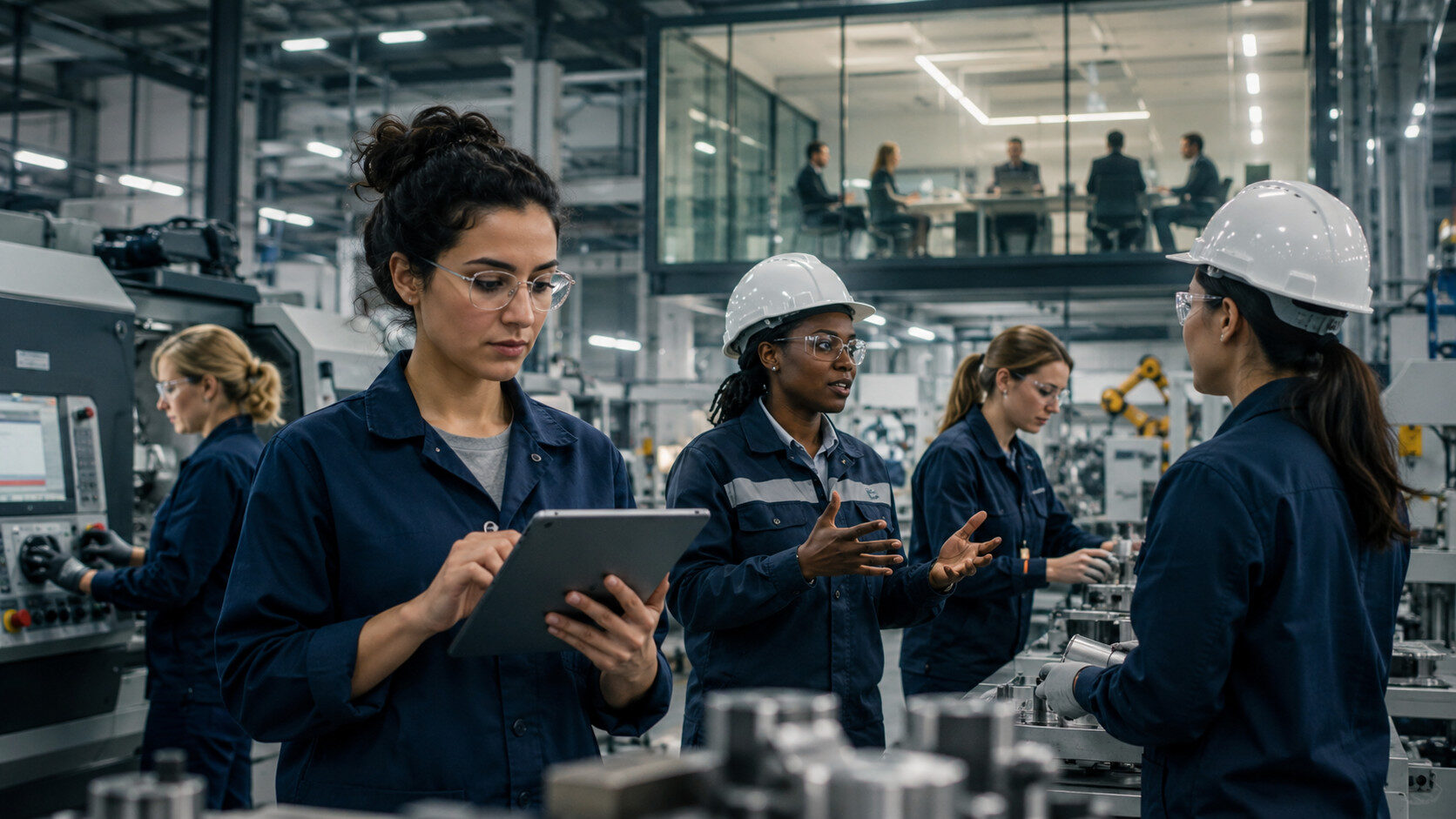
Women make up nearly half of all American workers. They represent 29% of the manufacturing workforce. That 18-point gap is not primarily explained by disinterest. It is explained by how the industry recruits, how it structures work, how it describes jobs, and what it has historically communicated — explicitly and implicitly — about who belongs in a plant.
Closing even a fraction of that gap doesn’t require a diversity initiative. It requires employers to look clearly at what’s creating it and make practical decisions to address it.
The Gap Is a Recruitment and Retention Failure, Not a Pipeline Problem
The common assumption is that women simply don’t pursue manufacturing careers — that the pipeline is thin and there’s nothing employers can do about it. The data doesn’t support this.
Since 2015, the number of tradeswomen has surged by 77.3%, reaching its highest recorded level in 2024. Women are entering manufacturing across every age group, which researchers note signals a sustainable pipeline rather than a short-term fluctuation. The pipeline exists. The problem is that employers aren’t tapping it effectively, and many women who enter manufacturing don’t stay long enough to advance.
The top barrier that female manufacturing workers cite is not compensation — it’s flexibility. 63.1% of women in manufacturing identify lack of workplace flexibility as their primary obstacle, compared to 38.8% of men. Shift structures that have been standard for 40 years made sense for a workforce with a particular domestic division of labor that no longer reflects how most households actually function. Employers who treat shift design as unchangeable are filtering out candidates before those candidates ever see a job posting.
The second barrier is visibility. Women are 12% less likely than men in manufacturing to receive leadership training, and the resulting absence of women in supervisory and management roles creates a feedback loop — when new female hires look up the org chart and see no one who looks like them in a leadership position, the message is clear, even if it’s unintentional. Companies with visible female leadership in operations roles attract more female candidates and retain them longer.
What the Job Description Is Actually Saying
Industrial job postings routinely filter out qualified female candidates through language choices that read as gendered signals rather than actual job requirements. Phrases like “must be able to lift 75 lbs unassisted” for roles where team lifts are standard practice. Physical requirement boilerplate that was never updated from 1990s templates. The word “aggressive” for target-setting. Descriptions heavy on military-derived terminology.
None of this is usually intentional. It’s the accumulated effect of job descriptions that were copied from previous posts and never reviewed through the lens of what message they send to a candidate who isn’t already assumed to belong in the role.
A straightforward audit of job postings — reviewing every physical requirement for accuracy, removing gendered language, focusing descriptions on what you actually need rather than what you’ve always asked for — is one of the lowest-cost, highest-impact changes an industrial employer can make to broaden their candidate pool.
Skills-based hiring frameworks take this further. They evaluate candidates on demonstrated capability rather than credentials and experience profiles that implicitly favor candidates who’ve already worked in environments where women are underrepresented. An aptitude assessment and a structured practical evaluation often surface qualified female candidates who would have been screened out by a resume filter.
The Business Case Is Not Complicated
Gender-diverse manufacturing companies are 25% more likely to achieve above-average profitability. Deloitte research found that leadership teams with meaningful female representation produce more innovative problem-solving and measurably higher profitability. Diverse production teams demonstrate lower error rates and higher engagement scores on manufacturing floors where the research has been done.
These outcomes are not primarily because women work differently than men. They are because teams with diverse perspectives approach problems differently than homogeneous teams — and in a manufacturing environment where continuous improvement, root cause analysis, and quality problem-solving are daily activities, the cognitive diversity of the team directly affects outcomes.
Retention data tells the same story from a different angle. Employers who actively recruit and develop female talent report lower overall turnover — not just among women but across the workforce — because the practices that make a facility attractive to women (flexible scheduling where possible, visible advancement, psychological safety to raise concerns) make it a better place to work for everyone.
What Forward-Thinking Industrial Employers Are Actually Doing
The manufacturers who are meaningfully changing their gender representation are not running diversity campaigns. They’re making operational decisions that happen to expand their talent pool.
Reviewing shift structures. Not every role needs to be on a rotating continental shift. For roles where schedule flexibility is operationally possible, offering it dramatically expands the candidate pool — and reduces turnover for workers already in those roles.
Building internal advancement programs. Formal pathways from operator to lead to supervisor — with documented criteria, active mentorship, and managers who are evaluated on whether they develop the people below them — produce female supervisors and managers over time. Those visible leaders are the most effective recruiting tool available for the next generation of candidates.
Partnering with trade schools and community colleges. Technical and community colleges are producing women with manufacturing-relevant skills at increasing rates. Employers who have active relationships with these programs — apprenticeships, co-ops, skills certifications — get access to candidates before they hit the general market.
Updating physical environment basics. Properly fitted PPE for women. Changing room facilities that aren’t an afterthought. These aren’t expensive changes, but their absence communicates that a facility wasn’t designed with a female workforce in mind — and candidates notice.
Taking harassment seriously. Production environments with documented or rumored harassment problems do not retain female workers. The employers gaining ground in this area are those where supervisors are trained, concerns are investigated, and accountability is visible — not just stated in a policy document.
The Competitive Advantage Is Available Right Now
The industrial employers who figure this out first — who access the female talent pool that their competitors are ignoring — will have a meaningful recruiting advantage for the next decade. Not because of how it looks externally, but because they will be drawing from a larger candidate pool, developing supervisors their competitors don’t have, and retaining workers who otherwise leave the sector.
The skills shortage is real. The candidate pool is tighter than it has been in a generation. And 47% of the U.S. workforce is substantially underrepresented in the industry complaining most loudly about not being able to find enough people.
The gap between those two facts is an opportunity, not a problem — for the employers who choose to treat it that way.
For industrial employers building a broader recruiting strategy: Connect with the Talent Traction team to discuss how your current sourcing approach can be expanded to reach the qualified candidates your standard process isn’t finding.
For women in industrial manufacturing exploring what the current market offers: Reach out to Talent Traction to confidentially explore opportunities at employers who are actively investing in developing their team.