Rubber manufacturing recruitment in 2026 operates in one of the tightest specialist talent markets in the entire industrial sector. The rubber and plastics products subsector employs approximately 940,000 workers in the United States — and 71% of employers in this space report struggling to find quality candidates for their open roles. The U.S. manufacturing sector as a whole faces a projected shortfall of 2 million workers over the next decade, with 3.8 million new manufacturing workers needed by 2033 and nearly half of those roles at risk of going unfilled.
Within that already-difficult landscape, rubber manufacturing presents a distinct and compounding challenge: the skills required to work in rubber — compound chemistry knowledge, elastomer processing experience, physical testing proficiency, cure system management — are acquired almost exclusively through direct industry experience. There are no large university programs producing rubber chemists at scale. There is no vocational certification track that reliably signals a qualified rubber compounder the way TIA credentials signal a qualified tire technician.
The result is a labor market where experience is the only real credential, experienced practitioners are a shrinking population, and the conventional hiring approaches — post a job, screen resumes, interview applicants — access a narrow slice of the available talent at best.
This guide is for HR directors, plant managers, and operations executives at rubber compounding facilities, molding operations, sealing manufacturers, hose and tubing producers, and technical rubber goods facilities who are watching their standard recruiting process consistently underdeliver — and who want to understand both why it’s happening and what a more effective approach looks like.
Why Rubber Is Harder to Recruit For Than General Manufacturing
Most manufacturing positions can be sourced from a broad pool of candidates with transferable skills — machine operation, quality inspection, maintenance work — that crosses industry lines. A packaging equipment operator can often be trained for a general production role in a different sector within a reasonable timeframe.
Rubber processing doesn’t work this way, at least not above the entry-level tier. The core technical roles — compounders, process engineers, quality engineers with physical testing depth, toolroom specialists — require knowledge that takes years to develop on the floor of a rubber operation. A candidate from a plastics facility has meaningful transferable skills but does not know how to read a cure curve or troubleshoot a Mooney viscosity deviation. A candidate from chemical manufacturing understands process discipline but hasn’t worked with elastomers.
This structural reality shapes every aspect of rubber manufacturing recruitment. The candidates you most need are experienced rubber practitioners. Experienced rubber practitioners are almost universally employed — the rubber manufacturing workforce shortage that is driving your search also means that anyone with genuine rubber experience has had no difficulty staying employed. And employed candidates do not respond to job postings.
The talent shortage is real. The candidates exist. The gap is between where those candidates are (working, not searching) and where most employers are looking (job boards).
The Five Hardest Roles to Fill in Rubber Manufacturing
Rubber Process Engineers and Compound Development Engineers
This is the single hardest role to fill through conventional recruiting in the sector. The candidate profile requires a combination of chemistry or polymer science knowledge, hands-on rubber compounding experience, and process development capability — a combination that is rare in any individual and almost never surfaces through inbound applications.
Most rubber process engineers with this profile are mid-career or senior professionals who are embedded in stable roles and not actively job-seeking. They are recruited through professional networks, industry relationships, and outbound sourcing — rarely through job boards. When they do consider a move, it is typically because a recruiter with rubber industry knowledge has reached them directly with a specific and well-articulated opportunity.
Rubber Compounders and Senior Process Technicians
Experienced compounders — professionals who understand elastomer systems, know how to read and interpret formulations, can operate internal mixers, and can troubleshoot compound variation — are among the most sought-after production-level roles in rubber. The talent pool is thin and aging. Many of the most experienced compounders in the workforce are within ten to fifteen years of retirement, and the generation behind them is smaller because rubber processing is not a well-publicized career destination for new entrants.
Recruiting compounders requires understanding exactly which elastomer families and processing methods the candidate has worked with, because the differences matter operationally. A candidate experienced primarily with EPDM and silicone may require meaningful development time in an operation that runs NBR or neoprene-dominated compound systems.
Quality Engineers with Physical Testing Depth
The specific combination of rubber physical testing proficiency — durometer, tensile, tear, compression set, Mooney viscosity, rheometry — with quality management system experience (IATF 16949, ISO 9001, AS9100) is genuinely uncommon and commands a premium. Most quality professionals have one side of this combination but not both. Those who have both are typically at facilities that value them accordingly and retain them well.
Maintenance and Reliability Technicians
Rubber manufacturing maintenance requires technical breadth that general maintenance recruitment rarely captures: hydraulics and pneumatics for press and calender systems, electrical and controls for automated lines, PLC programming familiarity for newer equipment, and physical mechanics specific to rubber processing machinery. The combination is hard to find in a single candidate, and the fact that industrial maintenance professionals are in shortage across all manufacturing sectors makes the search even more competitive.
Toolroom and Mold Technicians
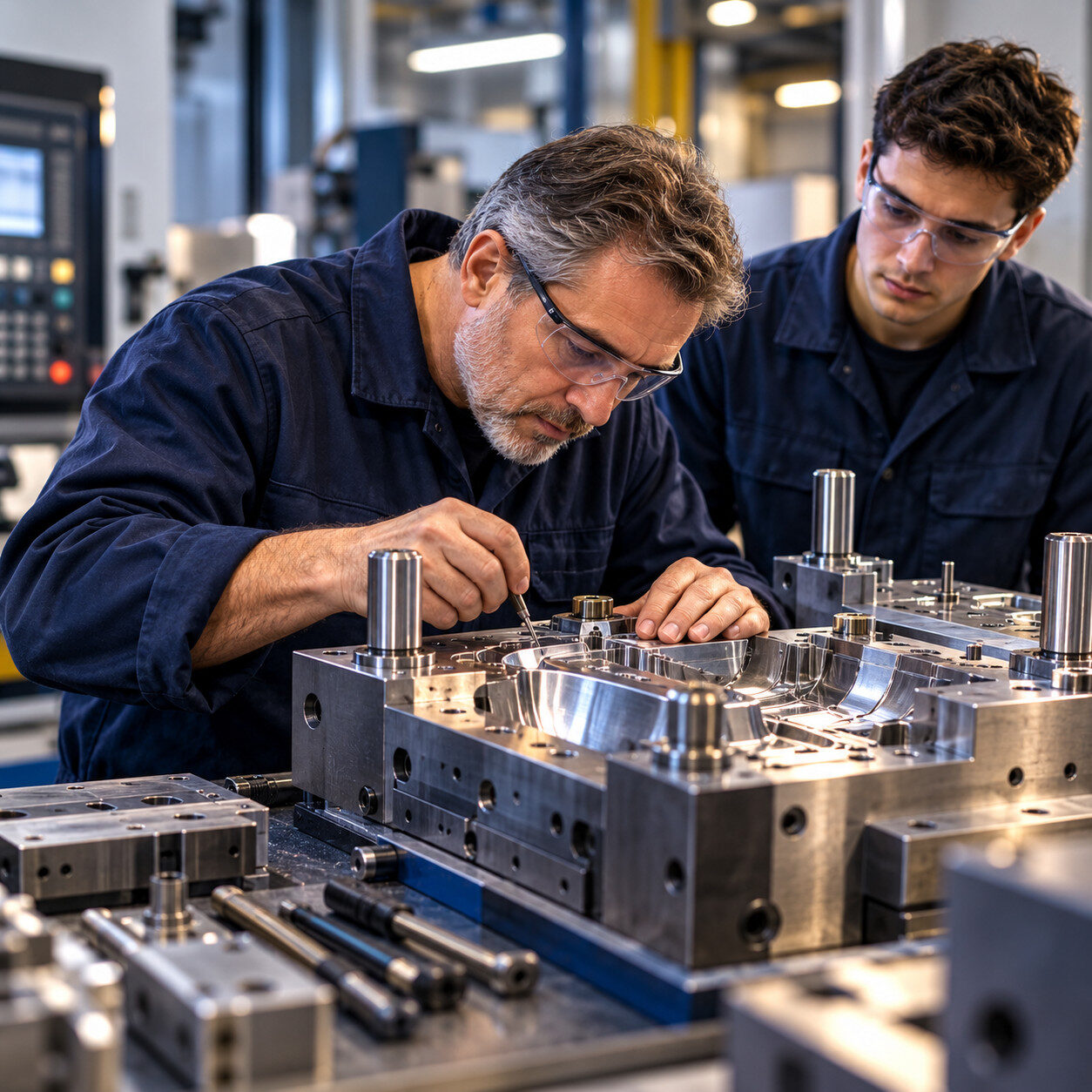
Rubber tooling knowledge — mold design and construction, tolerance requirements for rubber’s thermal expansion characteristics, cavity surface preparation, and release application — is a specialized craft that overlaps partially with plastics tooling and general machining but is not identical. Finding candidates with genuine rubber tooling experience requires active outreach into a small community of practitioners.
Why Job Boards Underperform in Rubber Recruiting
Experienced rubber practitioners are passive. Research consistently shows that approximately 85% of employed professionals are open to new opportunities but not actively searching. For rubber manufacturing specifically, this number skews even higher — the talent shortage means experienced rubber workers have no difficulty staying employed, and the ones most worth recruiting have the least reason to be scanning job boards.
Job postings attract credential proxies, not rubber expertise. A posting filtered by “5 years rubber manufacturing experience” and “bachelor’s degree in polymer science” will produce two types of responses: candidates who are qualified and happen to be actively searching (a small group), and candidates who have keyword-matched your requirements without the underlying competency (an increasingly large group, given AI-assisted applications). The experienced rubber process engineer or compounder who is currently employed and performing well is almost never in either category.
The vacancy cost compounds. The average time-to-fill for a production role in manufacturing is 42 days. For specialized rubber roles, that number is often significantly longer when relying on inbound applications. For a rubber process engineer vacancy in a facility running compound development, the cost is not just the salary of the unfilled role — it is the development work that doesn’t happen.
A More Effective Framework for Rubber Manufacturing Recruitment
Active Outbound Sourcing to Passive Candidates
Effective rubber manufacturing recruitment starts with a clear definition of the candidate profile — not a job description listing requirements, but a specific picture of the person you’re looking for: what elastomer systems they’ve worked with, what process role they’ve held, what their current role probably looks like, and what would motivate them to consider a move. That profile drives an active outreach process — identifying candidates who match it in the current workforce and reaching out directly with a specific, compelling opportunity.
This requires either an internal recruiting team with the time, tools, and rubber industry knowledge to execute outbound sourcing, or an external recruitment partner with an existing network in the rubber practitioner community.
Compensation That Reflects What the Market Is Actually Paying
One of the most consistent causes of failed rubber manufacturing searches is compensation set based on what the role paid eighteen months ago — before the market moved. Discovering this gap at the offer stage, after 60 to 90 days of searching, is an expensive version of a problem that can be prevented by benchmarking compensation before the search opens.
The rubber manufacturing salary guide documents what each role is actually paying in the current market. Organizations that have not updated compensation bands in the past 18 months are likely below market for process technician, process engineer, and quality engineering roles.
A Process Fast Enough to Close Candidates
Passive candidates who express interest in an opportunity have a short engagement window. They are currently employed, likely comfortable, and evaluating your opportunity against the stability of their current situation. A hiring process that takes eight to twelve weeks from first contact to offer will lose candidates who accepted offers elsewhere before yours was ready.
For rubber manufacturing roles, a competitive process moves from first contact to offer in three to five weeks for most positions. This requires pre-approved compensation ranges before the search starts, a defined interview process that doesn’t add rounds unnecessarily, and decision-making authority that doesn’t require multiple approval layers for every offer.
What to Look for in a Rubber Manufacturing Recruitment Partner
For facilities that lack the internal capacity to run effective outbound sourcing for specialized roles, an external recruitment partner can fill that gap — but the category of “manufacturing recruiter” covers a wide range of actual capability. The characteristics that distinguish effective rubber manufacturing recruitment partners are: a demonstrable network in the rubber practitioner community (not just manufacturing generally), the ability to articulate technical role requirements in terms that experienced practitioners recognize as credible, and current market compensation data specific to rubber roles.
The Talent Traction rubber manufacturing recruitment practice sources for rubber manufacturing roles through active outbound methods — identifying candidates with the right technical profile in the current workforce and presenting opportunities against a defined capability requirement, not a credential checklist.
Frequently Asked Questions About Rubber Manufacturing Recruitment
Why is rubber manufacturing so hard to recruit for?
Rubber manufacturing requires technical knowledge — compound chemistry, elastomer processing, physical testing — that is learned almost exclusively through direct industry experience. There are no large training pipelines producing rubber practitioners at scale. The experienced talent pool is aging and shrinking faster than it’s being replaced, and the practitioners most in demand are typically well-employed and not actively seeking new roles.
What roles are hardest to fill in rubber manufacturing?
The consistently longest searches are for rubber process engineers, experienced compounders, quality engineers with physical testing depth, maintenance technicians with rubber equipment experience, and toolroom and mold technicians. These roles require specific technical combinations that are rare in the general manufacturing workforce.
How long does it take to fill a rubber manufacturing role?
Time-to-fill for general production roles runs approximately 42 days across manufacturing. For specialized rubber roles — process engineers, quality engineers, senior compounders — searches relying on inbound applications frequently run 60 to 120 days or longer. Outbound sourcing to passive candidates can significantly reduce this timeline but requires an existing rubber practitioner network.
Should we use a specialist recruiter for rubber manufacturing?
For entry-level and general production roles, internal recruiting supported by job boards is often sufficient. For specialized technical, engineering, and leadership roles — where the ideal candidate is employed and not actively searching — specialist recruiters with active relationships in the rubber practitioner community provide meaningful time-to-fill and candidate quality advantages over generalist approaches.
Final Thought: The Candidates Are There — The Process Has to Reach Them
The experienced rubber practitioners your operation needs exist in the labor market. Many of them are at facilities within your region. A meaningful number would consider a better opportunity if it were presented to them directly, by someone who understands the work they do.
The recruiting process that reaches them is not a job posting. It is an active, outbound, relationship-driven search that finds the right candidates before they’re looking, presents a compelling case for the move, and closes quickly enough that the opportunity doesn’t lose to inertia.
For rubber manufacturing employers who need to fill specialized technical and engineering roles: Connect with the Talent Traction rubber manufacturing recruitment team to discuss your search and the current candidate market for the specific roles you’re trying to fill.
For experienced rubber manufacturing professionals exploring what the current market offers: Connect with Talent Traction to confidentially explore what opportunities exist for your background — even if you’re not actively looking.