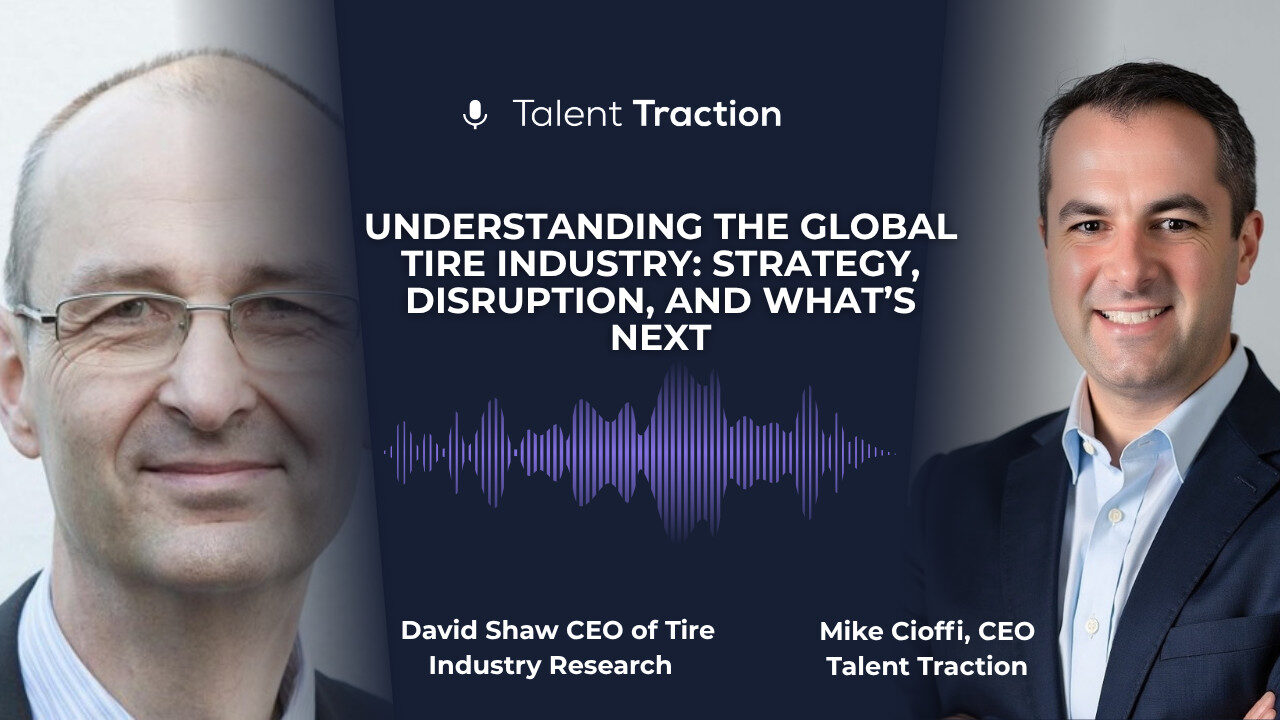
In this episode of the Talent Traction Podcast, host Mike Cioffi sits down with David Shaw, CEO of Tire Industry Research, one of the most respected analysts in the global tire market.
With decades of experience studying tire manufacturers, distribution networks, and global supply chains, Shaw brings a rare macro-level perspective on what’s actually happening beneath the surface.
And right now, the global tire industry outlook is defined by one thing:
👉 Structural change, not cyclical change.
Power Is Shifting Away from Manufacturers
For decades, tire manufacturers controlled the market.
They set pricing.
They controlled supply.
They dictated product strategy.
That dynamic is changing.
Today, large retail and wholesale networks:
- Control customer data
- Understand buying behavior
- Know pricing elasticity
- Influence product demand
As Shaw explains, these downstream players now have better visibility into the market than manufacturers themselves
That shift is subtle—but powerful.
👉 The industry is moving from supply-driven → demand-driven
Consumers Are Choosing Value Over Brand
The second major shift in the global tire industry outlook is consumer behavior.
Today’s buyers—both individual consumers and fleets—are under pressure:
- Inflation is persistent
- Operating costs are rising
- Budgets are tighter
So the buying decision has changed.
It’s no longer:
👉 “What’s the best brand?”
It’s:
👉 “What’s the best value?”
This shift is driving:
- Market share loss for premium brands
- Rapid growth for value-focused competitors
- Increased price sensitivity across segments
And importantly:
👉 Only about 25% of the U.S. market truly demands premium performance tires
The remaining majority is focused on affordability and practicality.
The Rise of Challenger Brands (“Jackals”)
David Shaw highlights a growing group of competitors—often referred to as “jackal brands.”
These companies are:
- Based largely in Asia
- Fast-moving and cost-efficient
- Hiring talent from Tier 1 manufacturers
- Focused on delivering “good enough” performance at better prices
They are not trying to beat premium brands at the top.
Instead, they are:
- Winning the lower and mid-market
- Building distribution
- Scaling volume
- Moving up the value chain
👉 This creates a bottom-up disruption model
And over time, that becomes very difficult to stop.
Premium Manufacturers Face a Strategic Dilemma
Tier 1 brands are now at a crossroads.
They have two choices:
Option 1: Protect Market Share
- Lower prices
- Compete across segments
- Maintain volume
Option 2: Protect Margins
- Focus on premium segments
- Accept lower volume
- Maximize profitability per unit
Most are choosing margin over volume.
But that comes with consequences:
- Declining production volumes
- Underutilized factories
- Increasing cost pressure
As Shaw explains, tire factories typically need ~80% utilization to remain profitable, yet many are operating far below that level
Factory Closures Are the Outcome—Not the Problem
This is why we’re seeing:
- Factory closures across the U.S. and Europe
- Reduced manufacturing footprints
- Strategic repositioning by major brands
Each year, major manufacturers are effectively losing the equivalent of a full factory’s worth of volume globally
👉 This isn’t temporary.
It’s structural.
Geopolitics and Tariffs Are Adding Chaos
Beyond market dynamics, global uncertainty is reshaping strategy.
Tariffs, trade tensions, and geopolitical risks are:
- Disrupting supply chains
- Increasing costs
- Delaying investment decisions
But the real issue isn’t tariffs themselves.
👉 It’s uncertainty.
As Shaw puts it:
👉 “Nobody knows what’s going to happen.”
And that lack of visibility is:
- Freezing hiring
- Slowing expansion
- Increasing risk aversion
The Iran Situation: Risk or Noise?
Recent tensions involving Iran have raised concerns across the industry.
But Shaw offers a balanced perspective:
Short-Term Impact
- Limited disruption due to high inventory
- Weak demand cushioning price increases
- No immediate crisis
Mid-Term Risk (Q3+)
- Supply constraints could emerge
- Prices may begin to rise
- Broader economic effects could hit
However, global production diversity—especially in China and India—provides some insulation.
👉 The real risk is prolonged disruption, not short-term events
Uncertainty Is Already Changing Leadership Behavior
One of the most overlooked impacts of this environment is on talent and leadership decisions.
Companies are:
- Hiring less
- Stretching existing teams
- Avoiding long-term commitments
This creates:
- Higher pressure on top performers
- Risk of burnout
- Slower innovation
The industry is operating in what many leaders describe as:
👉 “Wait and see mode”
What Will Separate Winners from Losers
So in a chaotic, shifting market—what actually matters?
David Shaw simplifies it into two core capabilities:
1. Low Cost Structure
As the industry commoditizes:
- Price competitiveness becomes critical
- Efficiency determines survival
- Margins depend on cost control
2. Agility
Winning companies:
- Plan for multiple scenarios
- Adapt quickly to change
- Empower fast decision-making
As Shaw highlights, businesses today must prepare for:
👉 Not just one outcome—but dozens of possible scenarios
Final Thought: This Is a Reset, Not a Decline
The global tire industry outlook is not about contraction.
It’s about redistribution of power, value, and strategy.
- Retailers are gaining influence
- Value brands are rising
- Premium players are repositioning
- Uncertainty is reshaping decisions
And in this environment:
👉 The winners won’t be the biggest players
👉 They’ll be the most adaptable ones