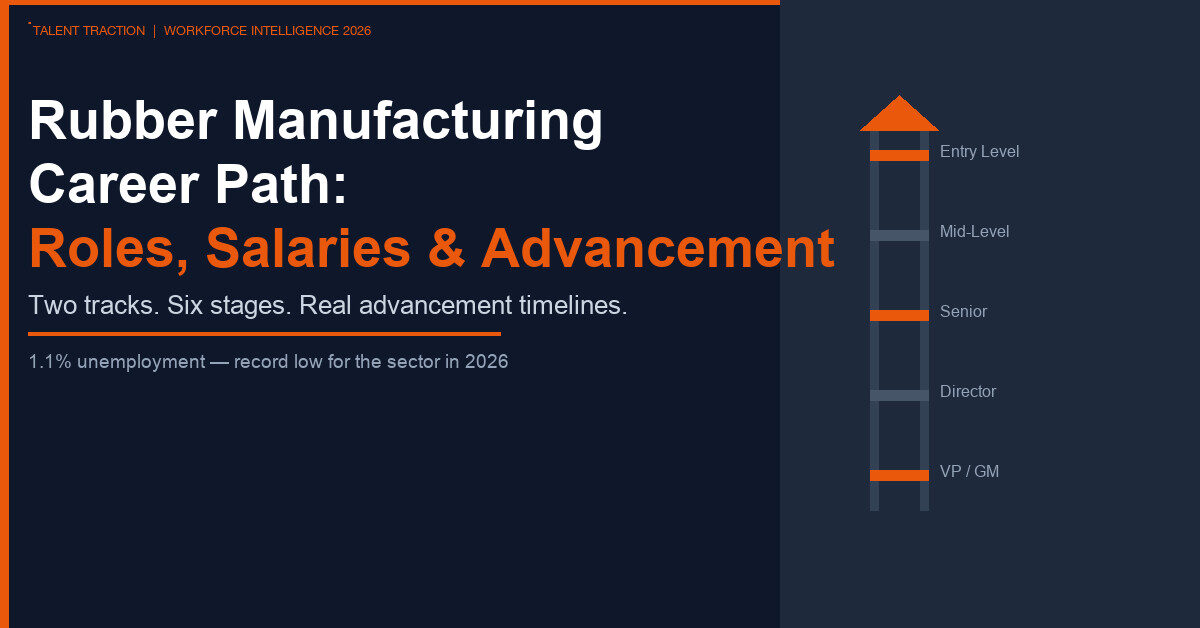
The rubber manufacturing career path is more structured — and more lucrative — than most people entering the industry realize. Plastics and rubber products manufacturing recorded a 1.1% sector unemployment rate in January 2026, the lowest January figure on record for the industry (Bureau of Labor Statistics, 2026). That number tells you something important: if you have the right skills at any stage of this career path, employers are competing for you — not the other way around.
The rubber industry employs more than 656,000 workers across the United States, in roles ranging from entry-level compound operators to six-figure plant managers and senior process engineers. What most career guides miss is that advancement in this sector follows two distinct tracks with different timelines, different education requirements, and different salary ceilings — and understanding which track fits your background is the most important decision you can make early in your rubber manufacturing career.
This guide maps the complete rubber manufacturing career path from entry level to senior leadership: what each stage pays, how long advancement typically takes, which certifications accelerate your trajectory, and how tire manufacturing careers differ from specialty rubber careers.
The Two Career Tracks in Rubber Manufacturing
Before mapping the stages, it is essential to understand that rubber manufacturing careers bifurcate early into two distinct progression routes.
The Technical Track runs from laboratory technician or process assistant through process engineer, senior engineer, technical director, and — at large companies — VP of Technology. This track is built on materials science, polymer chemistry, compound formulation, and process optimization. It typically requires a bachelor’s degree in chemistry, chemical engineering, or polymer science, though exceptional technicians can cross into the lower rungs through demonstrated expertise and employer-sponsored credentialing. Salary ceilings at the senior engineer and technical director level reach $150,000–$200,000+.
The Operations Track runs from production operator through production supervisor, operations manager, plant manager, and VP of Operations or General Manager. This track rewards leadership ability, process efficiency, safety performance, and the ability to drive production metrics. College degrees are common but not universal — many of the strongest plant managers in rubber manufacturing started on the floor and advanced through performance. The salary ceiling at the plant manager and VP level exceeds $195,000+ at major tire and specialty rubber facilities.
Both tracks share a common foundation in the first few years: technical proficiency, safety credibility, and the ability to earn trust in a demanding production environment.
Rubber Manufacturing Career Path: Entry Level — Years 0 to 3
Production Operator / Compound Operator
The most common entry point into rubber manufacturing. Works directly on the production floor operating mixing equipment, extrusion lines, molding presses, or curing systems. The role builds the foundational understanding of how rubber compounds are processed — the knowledge that is essential for advancement on either track. Salary range: $35,000–$48,000. Experienced skilled operators earning $48,000–$68,000 are increasingly difficult to find, and employers compete hard to retain them.
Laboratory Technician
Tests compound properties — hardness, tensile strength, elongation, cure characteristics — and assists process engineers with formulation development. This is the most direct entry point to the technical track, and the role most likely to earn employer-sponsored development investment. Entry salary range: $38,000–$52,000. Technicians who demonstrate analytical curiosity and initiative are frequently identified early for engineering development programs.
Maintenance Helper / Apprentice
Supports preventive and corrective maintenance of production equipment. The most common entry to a skilled trades career within rubber manufacturing, with a clear advancement path to maintenance technician and maintenance supervisor. Entry salary range: $36,000–$50,000. With industrial maintenance among the hardest roles to fill across all of manufacturing, entry-level maintenance hires who develop electrical and PLC competency can expect rapid salary growth.
The key at the entry level is not just competent execution — it is demonstrating the learning agility and technical curiosity that supervisors use to identify who receives development opportunities. Workers who ask why processes work the way they do, not just how to execute them, advance significantly faster.
Rubber Manufacturing Career Path: Mid-Level — Years 3 to 10
Process Engineer
Owns compounding formulations, mixing parameters, and vulcanization optimization for one or more product lines. Works closely with customers on application requirements and with production on process consistency. Consistently among the hardest roles to fill in the sector, which gives mid-career process engineers real negotiating leverage. Salary range: $88,000–$115,000. Senior process engineers with formulation depth reach $115,000–$145,000. Full benchmarks by experience tier and geography are covered in our rubber manufacturing salary guide.
Quality Engineer / Quality Manager
Manages quality systems, customer audits, corrective actions, and supplier quality programs. Roles with IATF 16949 scope in the automotive supply chain command the highest compensation and the most competitive recruiting market. The quality function has seen the steepest compensation appreciation of any rubber manufacturing role in the past 24 months as OEM customer requirements tighten and PPAP-credentialed professionals grow scarcer. Salary range: $88,000–$138,000 depending on level and scope.
Production Supervisor
Manages a shift or production area, accountable for output, safety, quality, and team performance. The first leadership role in the operations track — and the one that separates those who can lead from those who can only execute. Salary range: $72,000–$92,000, with night shift differentials adding $2,000–$6,000 annually. Supervisors who consistently develop their teams and improve production metrics are the ones who get noticed for operations manager and plant manager succession planning.
Sales Representative
Manages accounts or develops new business across tire manufacturers, distributors, or industrial end-users of rubber compounds. Requires technical credibility alongside commercial instincts. Base salary: $75,000–$100,000 with total compensation reaching $145,000–$148,000 for strong mid-level performers. One of the highest-ceiling roles in rubber manufacturing at the senior level.
The single most valuable investment a mid-career professional can make is completing formal credentials — Six Sigma Green or Black Belt, CQE or CQM from ASQ, or IATF internal auditor certification — while still in this stage. These credentials signal to employers that you can improve systems, not just operate within them.
Rubber Manufacturing Career Path: Senior Level — Years 8 to 20+
Senior Process Engineer / Technical Director
Leads compound development programs, drives formulation innovation, mentors junior engineers, and often serves as the primary technical interface with key OEM customers. At large tire manufacturers, Technical Directors own product families generating hundreds of millions in revenue. Salary range: $115,000–$165,000+, with director-level roles at major companies reaching $175,000–$200,000+.
Plant Manager
Full P&L accountability for a manufacturing facility. Oversees all production, quality, safety, maintenance, and HR functions. The most consequential hire in rubber manufacturing and the most competitive recruiting market in the sector. At large, complex facilities — multi-shift, 300+ headcount, high-complexity product mix — base compensation reaches $155,000–$195,000 with annual bonus potential of 15–25%, making total packages regularly above $220,000. Most plant manager searches are filled through specialist recruiters rather than job boards because the right candidates are almost never actively searching.
VP of Operations / General Manager
Multi-site or divisional accountability, typically requiring demonstrated plant manager success at one or more facilities. These roles are rarely posted publicly — most are filled through retained search or internal succession planning. Total compensation: $180,000–$275,000+ depending on scope and revenue under management.
Education and Certifications That Accelerate Advancement
The rubber manufacturing career path does not have a single education requirement — what matters varies by track and stage.
For the technical track: A bachelor’s degree in chemical engineering, polymer science, chemistry, or materials engineering is the standard entry point. Graduate degrees are increasingly common among those targeting Technical Director and VP of Technology roles. The ACS Rubber Division offers technical courses and rubber technology certificates recognized industry-wide.
For the operations track: A bachelor’s degree in engineering, operations management, or business is helpful but not universally required for the plant floor-to-supervisor transition. It becomes more important at the plant manager level and above. An MBA adds credibility for VP of Operations and GM candidates.
Credentials that accelerate advancement on both tracks:
- Six Sigma Green Belt / Black Belt — signals systematic process improvement capability; often required for operations manager promotions
- ASQ CQE (Certified Quality Engineer) or CQM (Certified Quality Manager) — the recognized professional standard for quality roles in manufacturing
- IATF 16949 Internal Auditor — essential for quality roles in automotive-supply rubber
- OSHA 30-Hour (General Industry) — expected for supervisory and management candidates
How Long Does Advancement Actually Take?
Based on placement patterns in the tire and rubber manufacturing sector, these are realistic advancement timelines for motivated professionals.
Technical Track:
- Entry lab tech / operator → Process Engineer: 3–5 years
- Process Engineer → Senior Process Engineer: 4–7 years
- Senior Engineer → Technical Director: 5–10 years
Operations Track:
- Entry operator → Production Supervisor: 3–6 years
- Supervisor → Operations Manager: 3–5 years
- Operations Manager → Plant Manager: 4–8 years
These timelines compress by 30–40% for professionals who combine strong on-the-job performance with deliberate credential building and exposure to multiple facility types. The professionals who advance fastest are not necessarily the most technically brilliant. They are the ones who build trust with leadership, consistently deliver on commitments, and voluntarily take ownership of problems above their current pay grade.
Tire Manufacturing vs. Specialty Rubber: How the Career Path Differs
Tire manufacturing (Bridgestone, Michelin, Goodyear, Continental, and their supplier tiers) offers the most structured career paths, strongest compensation packages, and most formalized development programs in the sector. Advancement tends to be more systematic with clearer promotion criteria. For operations leaders, tire manufacturing experience at a high-complexity plant is one of the most transferable credentials in all of manufacturing.
Specialty rubber (fluoroelastomers, silicones, medical-grade, aerospace-spec compounds) offers faster advancement for technically exceptional engineers because the candidate pool is smaller and the technical bar is higher. Compensation for specialty rubber engineers routinely meets or exceeds tire manufacturing benchmarks despite the smaller scale of operations.
Commodity rubber (standard seals, gaskets, molded parts) offers the most accessible entry point but typically carries lower compensation ceilings and less structured development. Professionals who build their production foundation in commodity rubber and then move to tire or specialty environments combine broad production experience with demanding technical standards — a combination that frequently accelerates advancement in the higher-complexity environment.
Frequently Asked Questions About the Rubber Manufacturing Career Path
How do I get into rubber manufacturing with no experience?
The most accessible entry points are production operator and laboratory technician roles, both of which require a high school diploma and train motivated candidates from scratch. Community college programs in manufacturing technology, chemistry, or industrial maintenance accelerate the transition. Once inside, consistent performance and curiosity about process improvement are the fastest paths to advancement. Explore entry-level and experienced opportunities on the Tire Talent job board.
What education do you need for rubber manufacturing?
Production and technician positions require a high school diploma. Process engineering and quality engineering roles typically require a bachelor’s degree in chemical engineering, polymer science, or materials engineering. Management and plant manager roles vary — many operations track professionals advance without a four-year degree, though a bachelor’s or MBA becomes increasingly expected at VP level. Technical certifications from the ACS Rubber Division and ASQ credentials often carry as much weight as academic credentials in mid-career advancement decisions.
What is the highest position in rubber manufacturing?
At the plant level, the Plant Manager role carries full P&L accountability and represents the peak of the single-facility operations track. Above that, VP of Operations and General Manager roles span multiple facilities or divisions. On the technical side, Technical Director and VP of Technology roles lead R&D and formulation programs company-wide. Total compensation at VP and GM level at major tire and specialty rubber manufacturers reaches $200,000–$275,000+.
How long does it take to become a plant manager in rubber manufacturing?
For most operations track professionals, the realistic timeline from entry-level to plant manager is 12–20 years. Accelerated timelines of 10–14 years are achievable for professionals who combine strong performance with deliberate exposure to multiple functional areas — quality, maintenance, production, and engineering — and who take supervisory accountability early. Formal credentials and experience at high-complexity multi-shift facilities consistently compress the timeline.
Final Thought: The Rubber Manufacturing Career Path Rewards Those Who Stay Curious
The rubber manufacturing career path is one of the most structurally sound in U.S. manufacturing — record-low sector unemployment, stable end markets, a skills shortage at the leadership level that gives experienced professionals genuine leverage, and compensation that reaches deep into six figures for those who invest in their development.
The professionals who advance furthest are not waiting for opportunities to appear. They are building the skills, credentials, and reputations that put them on the short list when the right role opens — often before it is ever posted publicly.
For job seekers: Explore active opportunities on the Tire Talent job board — from entry-level technician roles to senior engineering and plant management positions across the tire, rubber, and automotive manufacturing sector.
For employers: Connect with the Tire Talent team to discuss your current search needs and how we source candidates at every stage of the rubber manufacturing career path.