The automotive parts manufacturing workforce trends reshaping this industry in 2026 are not cyclical disruptions that will correct themselves when the economy stabilizes. They are structural — driven by electrification, accelerating automation, demographic change, and shifting immigration policy — and they are permanently altering who is available to hire, what skills they bring to the table, and how long you have to recruit them before a competitor does.
The numbers entering this year are sobering. Employment in motor vehicles and parts manufacturing fell by roughly 29,000 workers in 2025, even as production volumes held broadly steady (Bureau of Labor Statistics, 2026). The industry entered 2026 with fewer people on the floor, tighter teams, and almost no slack to absorb disruption. Average weekly hours in auto manufacturing remained near 42.8 — meaning the workers still present are already stretched. When a key role opens, the cost accumulates immediately.
This guide is written for HR directors, plant managers, and talent acquisition leaders at automotive parts manufacturers — and for the experienced industry professionals weighing their next career move in a market that is moving faster than most job descriptions acknowledge. Understanding the forces shaping the workforce is the first step toward building a strategy that stays ahead of them.
The State of the Automotive Parts Manufacturing Workforce in 2026
Employment by the Numbers
As of early 2025, approximately 995,800 workers were employed across U.S. vehicle and parts production — a figure that declined meaningfully after its post-pandemic peak. The auto parts sector specifically employed around 587,500 workers in January 2024, with that number contracting through the following year due to EV program delays, facility restructuring, and efficiency-driven headcount reductions at both OEMs and Tier 1 and Tier 2 suppliers.
The broader manufacturing sector is carrying approximately 4.2% of roles unfilled as of Q3 2025 (AMTEC Manufacturing Workforce Report, 2025). That may not sound like much, but in a facility running at 42-hour average weeks with limited bench depth, a handful of open positions in the wrong roles — maintenance, quality, process engineering — creates compounding pressure on everyone around them.
The slack that once existed in the hiring market is largely gone. When a senior technician gives notice, a quality manager retires, or a CNC operator accepts a competing offer, replacement timelines are now measured in months. Understanding why requires looking at the five forces currently reshaping the talent landscape.
5 Automotive Parts Manufacturing Workforce Trends Redefining Hiring in 2026
1. The EV Transition Is Eliminating Legacy Roles and Creating New Ones
The electric vehicle transition has moved more slowly than early forecasters predicted — but it has not stopped, and it has already produced significant workforce disruption across the automotive parts supply chain. Major manufacturers including General Motors and Ford spent much of 2024 and 2025 delaying EV production ramps and reducing shifts at affected facilities, with those decisions cascading through suppliers and triggering layoffs that affected tens of thousands of workers in parts manufacturing.
At the same time, manufacturers investing in EV-related production — battery pack assembly, power electronics, thermal management components — are encountering a hard ceiling on available talent. The competencies required for EV component manufacturing are genuinely different from traditional ICE parts: high-voltage systems knowledge, battery chemistry, embedded software integration. A machinist who spent 20 years producing engine blocks does not automatically transfer to a battery module assembly line.
For hiring managers, this creates a bifurcated talent market: an oversupply of workers whose traditional skills are contracting in demand, and a severe undersupply of workers with the competencies the growing segment of production actually needs. The organizations that close that gap fastest — through targeted upskilling, proactive sourcing, and accurate compensation benchmarking for hybrid-skilled roles — will hold a significant operational advantage through the end of the decade.
2. Automation Is Compressing Headcount Without Reducing Skill Requirements
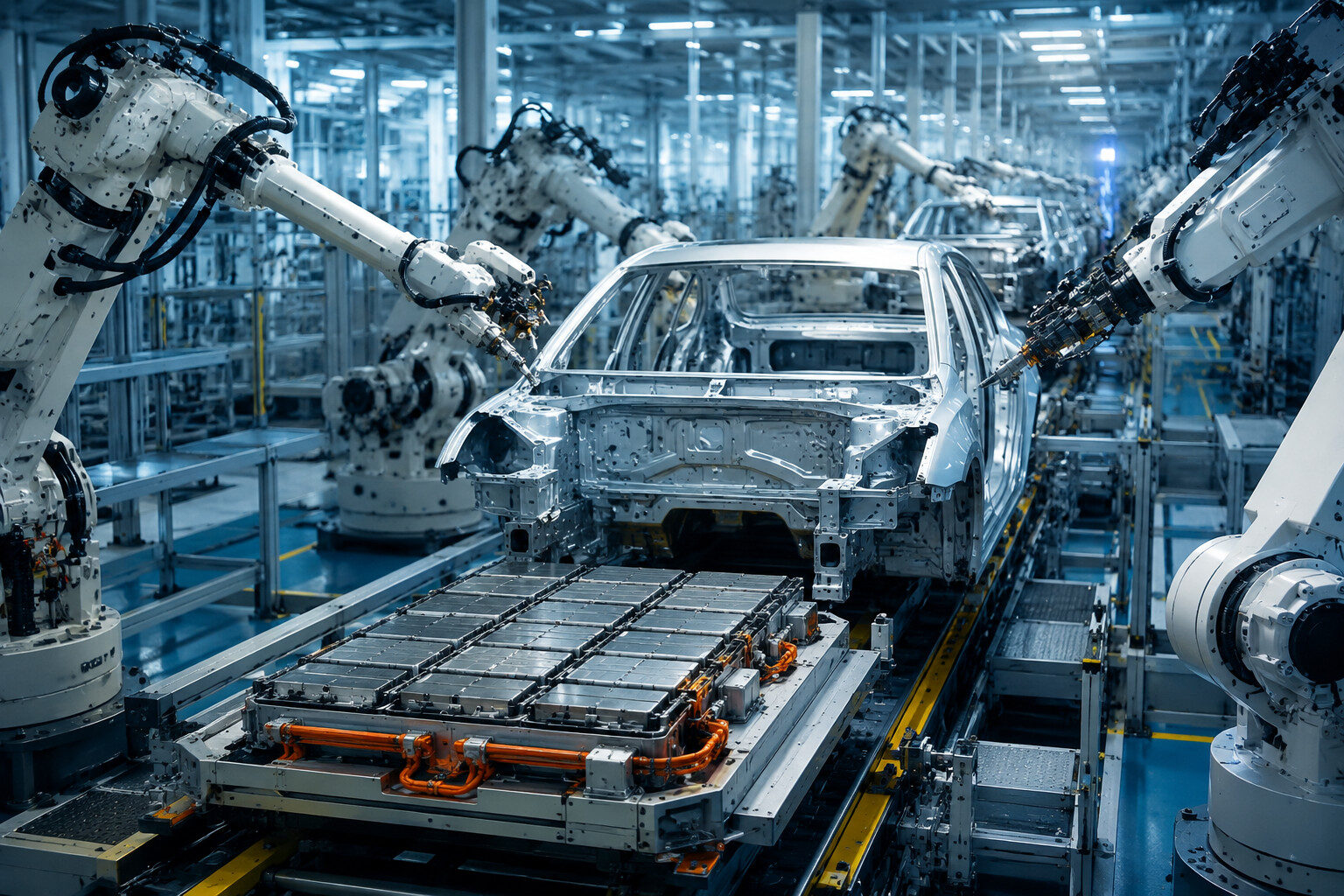
Robot installations in the U.S. automotive sector rose more than 10% in 2024 (International Federation of Robotics, 2024). Automotive has long been the most automated sector in U.S. manufacturing, but the pace of recent deployment has accelerated as manufacturers respond to higher labor costs and tighter staffing with capital investment.
What is frequently misunderstood about this trend is what automation is actually doing to the workforce. It is not simply eliminating jobs. It is eliminating the most repetitive, lowest-skill tasks while raising the skill floor for the positions that remain. The workers required on a modern automated automotive parts line — robot cell technicians, automation engineers, quality specialists, process engineers — are categorically more technically complex than the positions they replace.
This creates a compounding problem. The number of available workers with automation-adjacent skills is not growing as fast as the demand for them. A 2026 Deloitte Manufacturing Outlook report found that more than one-third of manufacturing executives cite workforce skills — not headcount — as their top talent concern. Hiring managers who treat this as a volume problem are misdiagnosing what is fundamentally a skills density problem: fewer workers needed, each one required to know meaningfully more.
3. An Aging Workforce Is Accelerating Succession Pressure
Nearly 25% of workers in automotive manufacturing are aged 55 and above. The baby boomer retirement wave that has been building for years is now producing daily succession challenges at parts manufacturers across the country — particularly in skilled trades and senior technical roles where institutional knowledge cannot be fully transferred through documentation or brief onboarding.
The challenge is not only that experienced workers are leaving. It is that the pipeline of younger workers entering automotive parts manufacturing has not kept pace with the departure rate. Manufacturing still carries a perception problem among workers under 35 — widely associated with environments that modern automated facilities long ago left behind, but the image persists in the career decisions of young people choosing between industries.
By 2030, the manufacturing industry could see up to 2.1 million jobs go unfilled, representing a potential economic loss of $1 trillion annually (Deloitte, 2024). Automotive parts manufacturers are not buffered from this trajectory — in several respects, they are at its leading edge. The roles most vulnerable are not entry-level production positions. They are the maintenance supervisors, quality managers, plant engineers, and senior technicians whose departure creates vulnerabilities that take 12 to 18 months of recruiting and ramp-up to recover from.
4. Immigration Policy Changes Are Shrinking the Available Labor Pool
The automotive parts manufacturing workforce has historically included a significant proportion of immigrant workers — particularly in production, assembly, and materials handling. In 2024, immigrant workers filled nearly one in four U.S. manufacturing production jobs. Policy changes affecting work authorization, visa processing, and enforcement priorities are reducing that labor pool at exactly the moment when domestic workforce development has not filled the gap.
For manufacturers operating in regions with historically high concentrations of immigrant labor — the Midwest corridor, Texas, the Southeast — the impact is already visible in recruitment data. Application volumes for entry-level production roles are declining in some markets. Time-to-fill for plant floor positions is extending. Turnover among remaining workers is increasing as workloads concentrate on smaller teams.
This is one of the most underleveraged conversations at the HR director level right now in automotive parts manufacturing. Organizations developing proactive workforce diversification strategies — including targeted outreach to domestically underrepresented talent pools such as returning veterans, rural workforce populations, and second-chance hiring programs — will be better positioned than those waiting for policy conditions to stabilize.
5. The Skills Gap Is Widening Faster Than Training Can Close It
Across all five of these trends, there is a consistent throughline: the skills required to work in automotive parts manufacturing in 2026 are categorically different from what was sufficient five years ago, and the training infrastructure to develop those skills at scale has not kept pace.
Community college automotive programs are still largely oriented around internal combustion engine systems. Apprenticeship programs in precision machining and industrial maintenance are undersubscribed in most markets. Employer-led training programs, while more common than they were, are inconsistently designed and rarely carry credentials that give workers portable proof of their new capabilities.
The organizations closing this gap most effectively are doing two things. First, identifying the specific skill adjacencies in their existing workforce — the workers who could transition from a contracting role to a higher-demand one with structured, targeted development. Second, building relationships with educational institutions and workforce development programs in their regions before the vacancy occurs, not after it opens.
What These Automotive Parts Manufacturing Workforce Trends Mean for Employers
The five trends above collectively describe a hiring environment that rewards preparation and punishes reaction. If your current strategy is to post a role when it opens and wait for applications, you are operating on a timeline that the 2026 labor market will not support for the roles that matter most. The most in-demand candidates — quality engineers, maintenance technicians, automation specialists, EV-adjacent professionals — are typically employed, rarely actively searching, and off the market within 10 to 14 days of beginning their search in earnest.
This means three practical changes. First, your compensation benchmarks need to reflect the current market. Rates for skilled automotive parts roles have shifted materially in the past 24 months, and if your approved salary bands were last updated in 2023, you are losing candidates at the offer stage without a clear understanding of why.
Second, your sourcing needs to include passive candidates — people who are not applying to job postings because they are not looking, but who would consider the right opportunity presented by the right person at the right time. Reaching this segment requires a different approach than job boards alone can provide.
Third, your time-to-hire needs to compress. If your process consistently runs 60 or 70 days from requisition to offer, you are arriving after the strongest candidates have already accepted elsewhere. That is not solely a recruiting problem — it is a process authorization problem that requires attention at the operations and HR leadership level.
Tire Talent specializes in automotive, tire, and rubber manufacturing recruitment and works with manufacturers at all tiers of the supply chain. If you are struggling to fill roles in this environment, we can help you move faster and reach candidates your current process cannot access.
What These Workforce Trends Mean for Job Seekers in Automotive Parts Manufacturing
If you are an experienced professional in automotive parts manufacturing — whether actively exploring options or simply watching the market — the current environment gives you more leverage than at any point in the past decade.
The skills in shortest supply right now — quality management, industrial maintenance, automation systems, EV component experience, process engineering — are being actively recruited for, often by multiple employers simultaneously. If you hold these competencies, your market value has increased, and the gap between what your current employer pays and what a competing employer would offer to secure your background may be larger than you realize.
The most important step you can take right now is getting a current read on the market. Explore current opportunities at Tire Talent or connect for a confidential conversation about your options. You do not have to be actively looking to benefit from knowing where you stand.
The Roles Hardest to Fill in Automotive Parts Manufacturing Right Now
Based on current recruitment patterns across the automotive supply chain, these positions are carrying the longest average time-to-fill and the sharpest employer competition in 2026:
Quality Engineers and Quality Managers — The combination of technical depth, process knowledge, regulatory awareness, and cross-functional communication that this role demands makes it consistently one of the hardest to fill from internal pipelines. Demand is running ahead of supply at virtually every supplier tier.
Maintenance Technicians and Maintenance Supervisors — Skilled trades pipelines have been underfunded for two decades. The available candidate pool is actively contracting as the role’s technical complexity increases with automation deployment.
Automation and Robotics Technicians — With robot installations accelerating, demand for workers who can commission, troubleshoot, and optimize automation cells has significantly outpaced supply, particularly outside major metro markets.
EV and Battery Systems Engineers — A role category that barely existed in the automotive parts supply chain five years ago and is now among the most competed-for positions, with OEMs, Tier 1s, and technology companies all recruiting from the same shallow talent pool.
CNC Machinists and Precision Manufacturing Specialists — Perennially in high demand, worsening as the experienced cohort ages and apprenticeship programs produce graduates well below replacement rate. Tire Talent actively recruits across all of these categories for manufacturers across the U.S.
Frequently Asked Questions About Automotive Parts Manufacturing Workforce Trends
How many people work in automotive parts manufacturing in the US?
As of early 2025, approximately 995,800 workers were employed across U.S. motor vehicle and parts production, with roughly 587,500 specifically in auto parts manufacturing (Bureau of Labor Statistics, 2025). Employment in the sector fell by approximately 29,000 workers during 2025, driven by EV program restructuring and efficiency-related headcount reductions, entering 2026 at a leaner baseline than any recent prior year.
How is the EV transition affecting jobs in automotive parts manufacturing?
The EV transition is contracting demand for workers tied to internal combustion engine components — fuel systems, exhaust components, traditional transmissions — while creating demand for workers with battery systems, power electronics, and thermal management expertise. The net effect varies by supplier and facility, but overall the transition is simultaneously reducing headcount at legacy operations while creating acute skill shortages at those investing in EV component production. Suppliers with diversified program portfolios are navigating this more successfully than those dependent on a single powertrain platform.
What skills are most in demand in automotive parts manufacturing in 2026?
The highest-demand skill sets in 2026 include: automation and robotics systems (programming, maintenance, troubleshooting); quality management and statistical process control; EV-related competencies including high-voltage systems and battery chemistry fundamentals; precision machining; and industrial maintenance with PLC and electrical systems experience. Deloitte research increasingly identifies cross-functional problem-solving and adaptability as deciding factors when technical qualifications are comparable between candidates.
Is automation replacing workers in automotive parts manufacturing?
Not straightforwardly. Automation is replacing specific task categories — primarily repetitive, lower-skill production tasks — while raising the technical requirements of the roles that remain. Workers at greatest risk are those whose roles consist primarily of tasks that can be reliably automated. Workers with cross-functional skills, technical problem-solving ability, and comfort operating within automated environments are in high demand, not at risk. The net result is fewer total workers needed, but each one required to hold meaningfully higher capability than five years ago.
Final Thought: Talent Strategy Is Now a Competitive Differentiator
The automotive parts manufacturing workforce trends defining 2026 will not resolve themselves. The demographic pressure, the skills gap, the EV transition disruption, and the tightening labor pool are structural realities that will persist through the end of the decade. Organizations that build proactive, intelligence-led talent strategies now — before the next wave of critical vacancies — will carry a measurable operational advantage over those that continue to react.
Whether you need to fill a critical role today or build the workforce architecture your facility needs for the next five years, the starting point is the same: an honest read on where the market actually is.
For employers in automotive parts manufacturing: Connect with the Tire Talent team to discuss your current hiring challenges and how a specialist recruiter can compress your time-to-fill on the roles that matter most.
For automotive parts manufacturing professionals: Explore active opportunities across automotive, tire, and rubber manufacturing — and find out what the current market says your background is worth.