Finding the best recruitment agencies for manufacturing in the USA has never been more urgent or more confusing. As of December 2025, there were 415,000 unfilled manufacturing job openings across the country, according to the U.S. Bureau of Labor Statistics’ Job Openings and Labor Turnover Survey (JOLTS). A Deloitte and Manufacturing Institute study projects that if the skills gap is not addressed, up to 1.9 million manufacturing positions could remain vacant by 2033, a shortfall that could cost the U.S. economy $1 trillion annually. In this environment, the recruitment agency you choose is not an administrative decision. It is a strategic one.
This guide is built for manufacturing HR directors, plant managers, and operations executives who are tired of sifting through generic staffing firms and need to understand exactly what a true manufacturing recruitment specialist looks like what they do differently, what questions to ask before hiring one, and what red flags signal that a firm is going to waste your time and budget.
The State of Manufacturing Hiring in 2026: Why This Is So Hard
Before evaluating any recruitment agency, it helps to understand the structural forces making manufacturing hiring so difficult right now. This is not a temporary tight market. It is a compounding crisis driven by three simultaneous trends.
The workforce is aging out. According to NAM’s Q3 2025 outlook data, the average manufacturer had approximately 4.2% of roles unfilled, with nearly one in four companies facing vacancy rates above 5%. Manufacturing’s workforce skews older than the national average, and replacement demand is rising faster than the sector can train new workers. Over 65% of respondents in NAM’s 2024 outlook survey identified attracting and retaining talent as their primary business challenge a concern manufacturers have ranked at the top of their list every single quarter since 2017.
The skills gap is widening, not closing. The 2024 Deloitte and Manufacturing Institute Talent Study identified something even more alarming than a skills gap: an applicant gap. It’s not just that candidates lack the right qualifications there are simply not enough people applying for open manufacturing positions at any skill level. Skill requirements are also evolving, spreading across traditional technical manufacturing knowledge, digital literacy, and soft skills simultaneously.
55% of manufacturing organizations reported increased time-to-hire in 2024, according to GoodTime’s manufacturing recruiting benchmarks report. For 2025 and into 2026, 53% of manufacturing talent leaders identified recruitment team turnover as their biggest internal disruptor, and 40% anticipated increased competition for talent.
The implication is straightforward: waiting for candidates to find you no longer works. The manufacturing companies filling roles in 2026 are the ones with proactive, relationship-based recruiting strategies often built around specialist partners, not internal teams working job boards.
What “Specialist” Actually Means in Manufacturing Recruitment
Not every agency that claims to work in manufacturing actually specializes in it. One of the most common mistakes manufacturing companies make when evaluating recruitment partners is accepting surface-level industry knowledge at face value. Here is what genuine specialization looks like versus what it doesn’t.
What a True Manufacturing Recruitment Specialist Does
A specialist agency maintains an active, maintained network of passive candidates meaning people who are currently employed and not actively applying for jobs. In a market where the best manufacturing talent is almost always employed, access to passive candidates is the single most important differentiator between a specialist and a generalist.
A specialist understands the functional nuances between roles. There is a significant difference between a process engineer, a manufacturing engineer, a quality engineer, and a plant manager in terms of skillset, compensation expectations, career trajectory, and what motivates each type of candidate to consider a move. An agency that cannot explain these differences in a first meeting is not a specialist, regardless of what their website says.
A specialist also understands the geography of manufacturing talent. Automotive talent is concentrated in the Midwest and Southeast. Aerospace talent clusters around major defense corridors. Chemical and industrial talent follows specific regional footprints. A good specialist knows where the candidates are and how to reach them not just how to post a job listing.
What a Generalist Looks Like (Even When They Claim to Specialize)
Generalist firms working in manufacturing typically rely on applicant tracking systems and job board responses. Their candidates are, by definition, the people who are actively searching which in manufacturing, often means the people who have already been passed over elsewhere or who left their last employer under difficult circumstances. That is not always true, but it is the structural risk of a volume-based, inbound-only recruiting model.
Generalists also tend to present candidates quickly rather than carefully. In a tight market, speed is valuable but not at the expense of fit. A study by Brandon Hall Group found that organizations that make bad hires lose an average of $240,000 per bad hire in productivity, turnover, and re-hiring costs. In manufacturing, where a bad plant manager or operations director can disrupt production schedules, supplier relationships, and employee morale for months, that number can be far higher.
The 7 Qualities That Separate the Best Manufacturing Recruitment Agencies from the Rest
Here is what to evaluate when vetting any manufacturing recruitment agency in the USA.
1. Deep Vertical Focus, Not Broad Industrial Coverage
The best agencies pick a lane. They recruit in automotive and don’t also do healthcare. They work in manufacturing and industrial sectors and don’t simultaneously run searches for financial services firms. Depth of specialization matters because manufacturing talent has a specific culture, a specific compensation landscape, and a specific set of career motivations that a recruiter learns through years of immersion not through a quick pivot.
Ask any agency: “What percentage of your completed placements in the last 12 months were in manufacturing roles?” If the answer is below 50%, you’re working with a generalist.
2. A Network Built on Relationships, Not Just Databases
Passive candidate outreach is everything in 2026. The best manufacturing recruiters are known in their niche. They have spent years building relationships with engineers, operations managers, plant directors, and supply chain leaders not because a search opened up, but because they invest in those relationships proactively.
When evaluating an agency, ask: “Tell me about a recent placement where your candidate was not actively looking for a job.” If they cannot give you a compelling answer, their network is a database, not a relationship.
3. A Structured Process, Not Just Activity
The difference between agencies that deliver and agencies that burn your time comes down to process. The best firms use a disciplined methodology: target-setting, talent mapping, candidate outreach and qualification, structured interviewing, reference validation, offer management, and post-hire follow-up. Every step has a cadence, a deliverable, and accountability.
Ask: “Walk me through your process from intake to candidate presentation.” Agencies with a strong process will describe it with confidence and specificity. Agencies without one will use vague language about “networking” and “leveraging their database.”
4. Transparency Over Promises
One of the most reliable signals of a strong agency is their willingness to tell you hard truths. If an agency tells you exactly what you want to hear about timeline and candidate availability without asking probing questions first, that is a warning sign. The best recruitment partners conduct a thorough intake process that genuinely diagnoses the difficulty of your search and then gives you an honest assessment of what it will take.
This includes being transparent about compensation benchmarks. Manufacturing salaries vary significantly by geography, role, and industry sub-sector. An agency that can tell you with precision what the market rate is for a quality manager in your specific location and sector and back it up with data is an agency that has done this work before.
5. Industry-Specific Market Knowledge
A strong manufacturing recruitment agency should be able to brief you on current market conditions before you brief them. They should know that manufacturing had 415,000 open jobs as of late 2025. They should know that average hourly earnings for all manufacturing employees reached $36.07 as of December 2025, according to BLS data. They should understand that automation and digital skills are reshaping job requirements across the sector, and that more than one-third of manufacturing executives cite workforce skills not headcount as their top talent concern.
If an agency cannot demonstrate current market knowledge in the first conversation, they are not going to add intelligence to your search process only execution.
6. Post-Placement Support and Accountability
The best manufacturing recruiters don’t disappear after offer acceptance. They check in during onboarding. They are the bridge between the new hire and the company during the critical first 90 days, when the vast majority of early attrition decisions are made. GoodTime’s benchmarks show that new hire no-shows and early departures are increasing partly because candidates have multiple offers and the engagement between offer acceptance and start date is often weak. A strong agency actively manages this gap.
Ask: “What does your post-placement support look like, and what guarantee do you offer if a hire doesn’t work out?”
7. Sector-Level Expertise Within Manufacturing
Manufacturing is not a monolith. Automotive manufacturing has different talent dynamics than aerospace, rubber and plastics, chemical processing, or industrial machinery. The best agencies have genuine expertise in specific sub-sectors, not just a general “manufacturing” practice that touches everything superficially.
If your operation is in a specific niche, prioritize agencies that have completed searches in that exact segment. A recruiter who has placed 30 quality engineers in the automotive sector in the last two years is going to deliver a meaningfully different candidate than one who places manufacturing professionals across 15 different industries.
Questions to Ask Every Manufacturing Recruitment Agency Before Signing an Agreement
To help you evaluate agencies efficiently, here is a practical set of questions that will separate genuine specialists from generalists in a single conversation.
On their specialization:
- What percentage of your placements last year were in manufacturing?
- Which manufacturing sub-sectors do you work in most frequently?
- Who is the most senior manufacturing executive you have placed in the last 12 months, and in what role?
On their candidate network:
- Describe a recent search where your winning candidate was not actively looking for a job.
- How do you maintain relationships with passive candidates between searches?
- Approximately how many manufacturing professionals do you have active relationships with, and in what geographic regions?
On their process:
- Walk me through your process from intake to candidate presentation.
- What does your typical time-to-first-presentation look like for a role like ours?
- How do you validate candidate qualifications beyond the resume?
On accountability:
- What guarantee do you offer on placements?
- How do you handle post-placement support?
- What happens if our hire leaves or doesn’t work out within the guarantee period?
On market knowledge:
- What is the current market rate for [specific role] in our location?
- What are the 2–3 biggest challenges manufacturing companies are facing right now in recruiting for this type of role?
- How has candidate behavior changed in the last 12 months?
If an agency answers these questions confidently and specifically, they are worth investing further time in. If they are vague, deflect to their website, or spend more time selling than answering, move on.
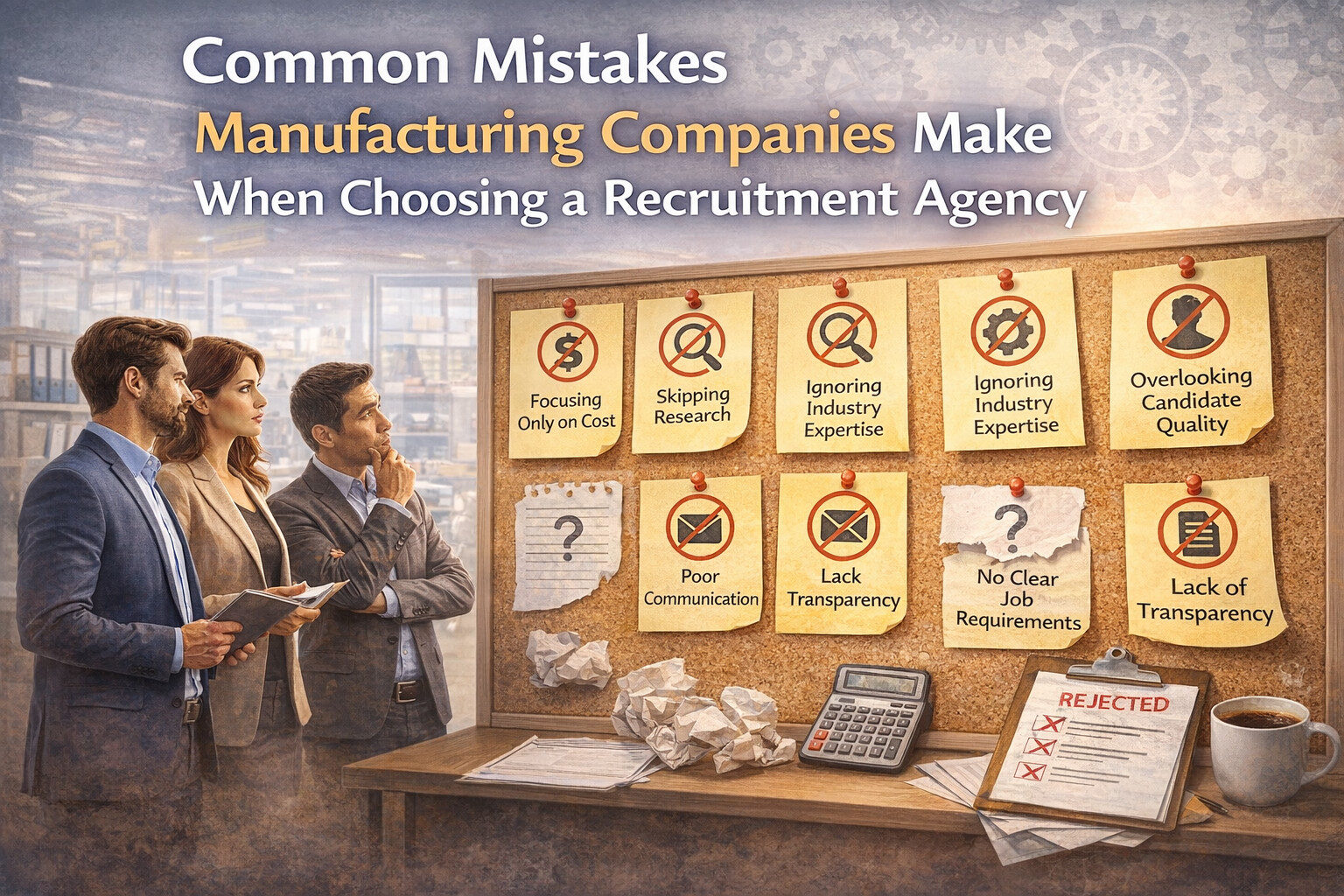
Common Mistakes Manufacturing Companies Make When Choosing a Recruitment Agency
Even sophisticated HR teams make avoidable mistakes when selecting a recruitment partner. Here are the most common ones.
Choosing on price alone. Recruitment fees are typically structured as a percentage of the placed candidate’s first-year salary. Choosing the agency with the lowest fee percentage often means choosing the one with the least investment in finding the right candidate. In manufacturing, where a plant manager or operations director might earn $120,000 to $180,000, the fee difference between a 15% and a 20% agency is $6,000 to $12,000. That is modest compared to the cost of a bad hire or a role sitting vacant for six months.
Using multiple agencies simultaneously for the same role. This is one of the most counterproductive things a manufacturing company can do. When multiple agencies are racing to fill the same role, they all rush to present candidates quickly rather than carefully. You end up evaluating a large volume of mediocre candidates rather than a curated shortlist of strong ones. It also signals to agencies that you don’t value the relationship, which means your search will be deprioritized in favor of clients who work exclusively.
Skipping the intake process. The quality of a recruitment agency’s output is directly proportional to the quality of the intake conversation. If you send a job description and expect results, you will be disappointed. The best agencies invest significant time upfront understanding your company culture, team dynamics, growth trajectory, and what specifically hasn’t worked about past hires. If an agency doesn’t ask these questions, don’t expect their presentations to reflect them.
Measuring success only by time-to-fill. Speed matters, but hire quality matters more. A role filled in 30 days with the wrong person costs far more than a role filled in 60 days with the right one. Define success metrics clearly with any agency before engaging: target time-to-fill, expected number of qualified presentations, 12-month retention rate, and post-placement check-in schedule.
Why Specialized Industrial Recruitment Partners Are Outperforming Generalists in 2026
The data on specialized versus generalist recruiting performance in manufacturing is compelling. According to MSH’s 2026 recruitment statistics, Recruitment Process Outsourcing (RPO) , which includes specialist agency partnerships, is growing at 18.5% annually as manufacturing companies recognize that internal HR teams and generalist agencies are not equipped for the current market.
Companies with strong employer branding and specialist recruitment partners are experiencing a 50% reduction in cost-per-hire compared to those using generalist or volume-based approaches. Referral hires a core output of relationship-based recruiting are placed 55% faster than candidates from traditional sourcing. These are not marginal advantages. In a market where 55% of manufacturers say time-to-hire is increasing and 40% expect talent competition to intensify in 2026, they translate directly into competitive positioning.
The manufacturing companies winning the talent war in 2026 share a consistent profile: they have made talent acquisition a strategic priority rather than an HR function, they work with a single trusted specialist partner rather than a rotating roster of generalists, and they invest in the relationship with that partner the same way they invest in relationships with key suppliers with transparency, mutual accountability, and a long-term perspective.
What the Best Manufacturing Recruitment Agencies Won’t Tell You (But Should)
There are a few things worth knowing that most agencies, even good ones, don’t proactively communicate.
Your job description is probably part of the problem. Many manufacturing job descriptions are written for compliance, not attraction. They list requirements without communicating career opportunity, company culture, or why someone who’s already employed should take your call. A strong recruitment partner will tell you this diplomatically but clearly and help you reframe the opportunity in a way that resonates with passive candidates.
Compensation benchmarks matter more than you think. In a market where average manufacturing earnings reached $36.07 per hour as of December 2025, companies that haven’t updated their salary ranges in 18 months are competing with one hand tied behind their back. If your target compensation is 15–20% below market, the best candidates will not make it past the first conversation. A good agency will tell you this upfront, even if it’s uncomfortable.
The best candidates will have competing offers. In a market with 415,000 open manufacturing positions, any strong candidate you want is a candidate other companies want too. Hiring processes that take six or eight weeks from first interview to offer letter will consistently lose their top choices. The best agencies will push you to accelerate decision-making not because they want to rush you, but because they know the market doesn’t wait.
What to Expect When You Work with a Specialist Manufacturing Recruitment Agency
Here is what a high-quality engagement looks like from start to finish.
Week 1–2: Intake and target-setting. A thorough intake covering the role, team context, company culture, compensation range, timeline, and what specifically hasn’t worked about past hires. Development of a candidate profile and a target company list for outreach.
Week 2–4: Active sourcing and outreach. Direct outreach to passive candidates in the target profile. Initial screening conversations to qualify interest, experience, and compensation alignment.
Week 3–5: Qualified candidate presentation. A curated shortlist typically 3 to 5 genuinely qualified, pre-screened candidates with detailed summaries of each person’s background, motivation for considering a move, and fit assessment.
Week 5–8: Interview coordination and offer management. Management of interview scheduling, candidate feedback, and critically offer negotiation and acceptance management to minimize dropout between offer and start date.
Week 8+: Post-placement support. Check-ins at 30, 60, and 90 days to ensure integration is on track and to surface any early concerns before they become retention risks.
This is the standard you should hold any manufacturing recruitment agency to. If the process a firm describes to you is less structured than this, you are likely looking at a firm that relies on volume rather than quality.
Summary: How to Choose the Best Recruitment Agency for Your Manufacturing Business
|
Criterion |
What to Look For |
Red Flag |
|
Specialization |
50%+ of placements in manufacturing |
“We work across all industries” |
|
Candidate Network |
Relationship-based, passive candidates |
Database-only sourcing |
|
Process |
Structured, documented, accountable |
Vague promises about “networking” |
|
Market Knowledge |
Current salary data, sector trends |
Can’t benchmark compensation |
|
Transparency |
Tells you what you need to hear |
Tells you what you want to hear |
|
Post-Placement |
30/60/90-day check-ins and guarantee |
Disappears after placement |
|
Sub-Sector Expertise |
Deep in your specific manufacturing niche |
General “industrial” experience only |
Final Word: The Right Partner Changes Everything
The U.S. manufacturing sector faces a structural workforce challenge that will not resolve itself through economic cycles alone. With up to 1.9 million jobs potentially unfilled by 2033, the companies that invest in strategic, specialist recruitment partnerships now will build a meaningful competitive advantage not just in filling roles, but in building teams that can execute against growth objectives while the rest of the industry struggles to staff basic operations.
The best manufacturing recruitment agencies in the USA are not the biggest ones, or the cheapest ones, or the ones with the most polished websites. They are the ones that know your industry well enough to challenge you, know the candidate market well enough to find people you couldn’t find yourself, and care enough about the outcome to stay engaged long after the placement is made.
If you’re evaluating recruitment partners for your manufacturing operation whether you need to fill a single critical leadership role or build out an entire plant team, Talent Traction specializes exclusively in industrial and manufacturing recruitment. Our team brings deep sector knowledge, a relationship-first candidate network, and a structured process built around one goal: the right hire, in the right role, built to last.