The Tire Industry Outlook for 2026 is defined by consolidation, private equity expansion, and a generational ownership shift across retail, wholesale, and auto repair. Capital continues flowing into the space, valuations remain strong for quality operators, and succession planning is no longer optional; it’s strategic.
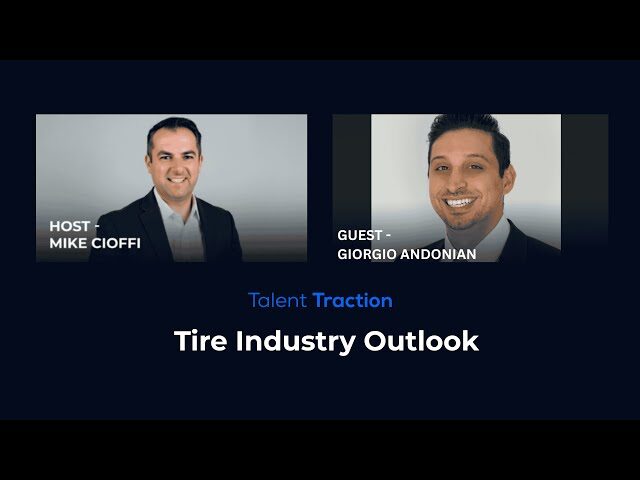
In this episode of The Talent Traction Podcast, Mike Cioffi sits down with Giorgio Andonian, Managing Director at FOCUS Investment Banking, to break down what tire retailers, service operators, and multi-location groups need to understand about valuation, growth strategy, and long-term positioning.
The message is clear: valuation isn’t created in a deal room. It’s built in daily operations.
Consolidation Is Active But Buyers Are More Selective
From an investment banking perspective, the Tire Industry Outlook remains strong. Private equity firms continue entering the auto aftermarket. Strategic buyers are expanding platforms. Multi-location operators are seeking capital to grow.
Valuations are not at 2021’s peak frenzy but for strong businesses, they remain close.
The difference in 2026?
Buyers are more disciplined.
They’re prioritizing:
- Consistent EBITDA performance
- Clean financial reporting
- Leadership depth
- Reduced volatility
- Scalable infrastructure
Good businesses are still commanding strong multiples. Average or inconsistent ones are seeing pricing pressure.
The market rewards preparation.
How Valuation Really Works in 2026
Most transactions in the tire and auto aftermarket space are anchored around EBITDA multiples. Some strategic buyers use revenue-based formulas tied to tire units and internal modeling, but everything ultimately comes back to sustainable cash flow.
One important nuance in this Tire Industry Outlook discussion is the concept of:
Four-Wall EBITDA vs. Fully Loaded EBITDA
If a buyer already has HR, accounting, and operational infrastructure, they may not need your back-office costs. That allows them to evaluate performance based on “four-wall EBITDA” store-level profitability without redundant overhead.
If the buyer does not have infrastructure, those costs remain.
The same business can produce different valuation outcomes depending on the buyer.
Understanding buyer type matters.
The Hidden Valuation Risk: Owner Dependency
One of the most common issues affecting deals is key-man risk.
Buyers ask simple questions:
- Can the owner take two weeks off without disruption?
- Is there a management team making independent decisions?
- Is there a clear succession plan?
If the owner is the sole decision-maker, valuation often reflects that risk.
Reducing owner dependency increases transferability and transferability increases enterprise value.
Leadership structure directly impacts long-term valuation.
The Biggest Mistake Operators Make
According to Giorgio, the most common mistake is failing to prepare years in advance.
Many owners think about selling when they feel emotionally ready. But valuation is shaped by years of operational behavior not last-minute adjustments.
Preparation should begin 3–5 years before any transaction and include:
- Clean, organized financial statements
- Clear documentation of add-backs
- Defined corporate structure
- Leadership development
- Succession planning
- Margin consistency
When you build your company as if it might sell tomorrow, you create leverage even if you never sell.
That’s a key takeaway from this Tire Industry Outlook conversation.
What Buyers Evaluate Beyond the P&L
Financial performance matters but it’s not enough.
Buyers evaluate:
- Management depth
- Financial clarity and reconciled books
- Revenue stability
- Technician retention
- Training programs
- Growth runway
Volatility creates hesitation. One difficult year can be explained. Recurring swings suggest structural issues.
Consistency builds confidence. Confidence preserves valuation.
Training as a Strategic Advantage
One overlooked theme in this Tire Industry Outlook is the role of technician development.
Strong operators consistently invest in:
- Certification programs
- Supplier-supported training
- Career progression paths
- Skill expansion
The short-term cost of training produces long-term benefits:
- Higher margins
- Fewer comebacks
- Expanded service offerings
- Stronger retention
Investors and buyers recognize when a company has invested in its people. It signals operational maturity and long-term durability.
Operational excellence compounds and compounding improves enterprise value.
Consolidation Will Continue But So Will Entrepreneurship
The Tire Industry Outlook suggests consolidation will remain strong due to:
- Baby boomer retirements
- Private equity platform expansion
- Increased access to capital
However, not every independent is destined to sell.
Many operators are choosing to grow raising capital, expanding rooftops, and building regional scale before considering an exit.
By scaling first, owners can significantly increase future enterprise value compared to selling too early.
The industry remains fragmented, particularly in auto repair. That fragmentation creates opportunity for disciplined operators.
Platform vs. Add-On: Why Scale Changes Outcomes
In M&A terms, a “platform” typically refers to a business generating roughly $2–3 million or more in EBITDA large enough to serve as the foundation for investment.
Platform companies generally command stronger multiples.
Smaller businesses transact as add-ons at different pricing structures.
Understanding where your company fits in that ecosystem shapes long-term strategy.
The Most Practical Advice for 2026
If there’s one action every operator should prioritize entering 2026:
Get your books in order.
Whether you plan to:
- Sell
- Raise capital
- Expand
- Refinance
- Or simply improve operational clarity
Clean financial reporting builds trust.
Messy books create friction. Friction reduces leverage. Reduced leverage impacts valuation.
Financial discipline is strategic positioning.
Final Takeaway
The Tire Industry Outlook for 2026 is strong. Capital is active. Cars aren’t disappearing. Repairs aren’t disappearing.
But valuation is no longer automatic.
The businesses that command premium outcomes will be those that:
- Develop leadership depth
- Reduce owner dependency
- Invest in technician development
- Maintain consistent margins
- Keep clean financial records
- Plan succession early
Valuation is not a last-minute calculation.
It’s the result of disciplined leadership.