The talent acquisition trends automotive manufacturers face in 2026 are no longer incremental changes; they are structural shifts that will determine which organizations scale and which quietly fall behind.
For decades, automotive hiring followed a familiar pattern: experienced engineers, plant supervisors who worked their way up, predictable labor pipelines from trade schools, and long employee tenures. That model is breaking.
In its place is a far more complex reality shaped by automation, electrification, demographic change, AI adoption, and rising competition for the same shrinking talent pool. In 2026, manufacturers are discovering that talent acquisition is no longer an HR function, it’s a core business strategy.
This article breaks down the most critical talent acquisition trends automotive manufacturers cannot ignore in 2026, backed by data, real-world hiring behavior, and what forward-thinking companies are already doing differently.
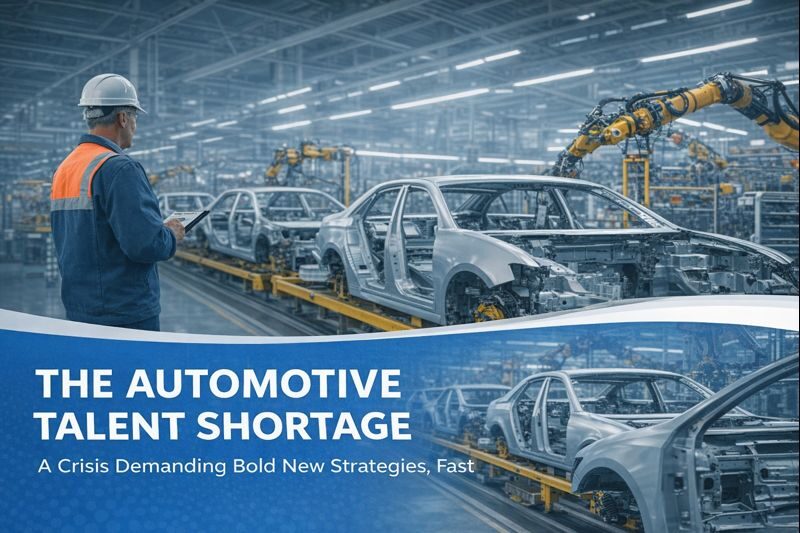
1. The Automotive Talent Shortage Is Structural Not Cyclical
For years, many leaders treated hiring challenges as temporary labor market noise. In 2026, that illusion is gone.
The data reality
- The U.S. manufacturing sector is projected to have 2.1 million unfilled jobs by 2030 (Deloitte & The Manufacturing Institute).
- Automotive and transportation manufacturing account for one of the largest skill gaps, particularly in:
- Advanced manufacturing
- Automation maintenance
- EV systems
- Quality and process engineering
- More than 25% of the automotive workforce is over age 55, accelerating retirements.
This is not a short-term hiring dip. It’s a long-term demographic and skills mismatch.
What this means for talent acquisition:
Manufacturers can no longer rely on “post-and-pray” recruiting or last-minute hiring. Workforce planning must extend 3–5 years forward, with talent acquisition embedded into operational strategy.
2. EV and Electrification Are Redefining “Qualified Talent”
One of the most disruptive talent acquisition trends automotive manufacturers face is the rapid shift toward electric vehicles.
Why EV hiring is different
EV manufacturing requires skills that traditional ICE plants didn’t prioritize:
- High-voltage systems
- Battery chemistry and thermal management
- Power electronics
- Software-hardware integration
- Advanced diagnostics
Yet most experienced automotive talent was trained in mechanical-first environments.
The 2026 challenge
Manufacturers are competing with:
- Tech companies
- Energy firms
- Battery startups
- Aerospace manufacturers
Many automotive firms are discovering that waiting for “perfect-fit” candidates is no longer viable.
Winning strategy in 2026:
- Hire for adjacent skills, not identical resumes
- Invest in structured upskilling and internal academies
- Partner with technical colleges and OEM-aligned training programs
Talent acquisition teams that understand skill adjacency, not just job titles are outperforming their peers.
3. Entry-Level Automation Is Quietly Breaking the Leadership Pipeline
Automation is delivering real efficiency gains but it’s also creating unintended talent consequences.
The overlooked risk
- Over 40% of manufacturers plan to automate entry-level operational roles by 2026.
- Historically, these roles were where future supervisors, managers, and plant leaders learned the business.
By removing these positions, organizations are creating what many now call a “hollow middle” workforce:
- Senior leadership at the top
- Highly automated operations at the bottom
- Fewer experienced mid-level leaders in between
Talent acquisition implication
Manufacturers are realizing too late that leadership cannot be hired externally at scale. It must be grown.
2026 response:
Forward-thinking firms are introducing:
- Rotational leadership programs
- Cross-functional plant assignments
- “Artificial experience” tracks that simulate ground-up learning
Talent acquisition is now tightly linked to succession planning, not just requisition filling.
4. Hiring Speed Is Now a Competitive Advantage
In 2026, the best automotive candidates are off the market in 10–14 days.
Yet many manufacturers still operate with:
- Multi-week approval cycles
- Unstructured interviews
- Delayed feedback loops
What the data shows
- Companies with streamlined hiring processes fill roles 30–40% faster
- Faster hiring correlates directly with higher candidate quality and acceptance rates
Key trend:
Talent acquisition teams are being measured not just on cost-per-hire, but on time-to-productivity impact.
What top manufacturers are doing
- Pre-approved talent pools
- Parallel interviews instead of sequential ones
- Hiring manager accountability metrics
- Clear compensation bands upfront
Speed isn’t about cutting corners, it’s about removing friction.
5. Salary Transparency Is Becoming Non-Negotiable
Automotive manufacturers were historically cautious about publishing pay ranges. In 2026, that approach is actively harming applicant flow.
The numbers
- Job postings with salary ranges receive 1.8–2.2x more qualified applicants
- States like California, New York, and Colorado now mandate pay transparency
- Candidates increasingly interpret missing salary data as a red flag
The internal fear
“We don’t want current employees to know.”
The reality
They already do.
2026 shift:
Leading manufacturers are:
- Publishing realistic pay ranges
- Aligning internal equity proactively
- Using transparency as a trust signal not a risk
Talent acquisition teams that embrace transparency are seeing higher-quality, more committed applicants.

6. Employer Brand Now Matters in Manufacturing
For years, employer branding was seen as a “tech company thing.” Not anymore.
Why employer brand matters in 2026
- Gen Z and Millennial candidates research employers deeply
- Glassdoor, Reddit, and LinkedIn shape perception
- Candidates want purpose, not just paychecks
Automotive-specific expectations
Candidates increasingly ask:
- What’s the company’s EV roadmap?
- How does leadership invest in people?
- Is this a place where I can grow or get stuck?
Winning manufacturers are telling clearer stories about:
- Innovation
- Safety culture
- Career progression
- Leadership development
Talent acquisition and marketing are now tightly aligned.
7. Data-Driven Hiring Is Replacing Gut Feel
Another major talent acquisition trend automotive manufacturers can’t ignore is the shift from intuition-based hiring to evidence-based decisions.
What’s changing
- Predictive analytics for turnover risk
- Structured interview scoring
- Performance-linked hiring data
- Skills matrices replacing resumes
Why it matters
Bad hires in manufacturing are expensive:
- Lost productivity
- Safety risks
- Quality failures
- Management burnout
In 2026, data isn’t optional, it’s protective.
Manufacturers using structured hiring frameworks are seeing:
- Lower first-year attrition
- Faster ramp-up times
- Stronger leadership pipelines
8. The Role of Specialized Recruiting Partners Is Expanding
Generalist recruiters struggle to understand:
- Plant-level realities
- Niche automotive roles
- Safety and compliance requirements
What manufacturers want now
- Industry-specific recruiters
- Deep technical screening
- Access to passive candidates
- Strategic workforce insights
Recruiting partners are no longer just vendors, they’re extensions of the leadership team.
9. Remote, Hybrid, and Flexible Models Are Here to Stay Selectively
Not every role can be remote but ignoring flexibility entirely is costing manufacturers talent.
2026 reality
- Engineering, design, analytics, and leadership roles increasingly expect flexibility
- Companies offering hybrid options see broader talent pools
- Flexibility is now a retention tool, not just a perk
The manufacturers winning in 2026 are intentional, not ideological, about flexibility.
10. Talent Acquisition Is Moving Into the Boardroom
Perhaps the biggest shift of all: talent acquisition is now a C-suite conversation.
Boards are asking:
- Who will run this plant in 2030?
- Do we have internal successors?
- What happens if key leaders retire?
Talent acquisition leaders are now expected to:
- Present workforce risk assessments
- Model future skill gaps
- Align hiring strategy with capital investment plans
This is no longer transactional hiring it’s strategic talent architecture.
Final Thoughts: 2026 Is a Defining Year for Automotive Talent
The automotive manufacturers that thrive in 2026 will not be the ones with the most automation but the ones who balance technology with people strategy.
The most important talent acquisition trends automotive manufacturers must act on now include:
- Planning beyond immediate headcount
- Building leadership pipelines intentionally
- Hiring for skills, not resumes
- Moving faster and more transparently
- Treating talent as a long-term asset, not a variable cost
Those who adapt will build resilient, future-ready organizations.
Those who don’t will find themselves asking a dangerous question a few years from now:
“Why didn’t we see this coming?”