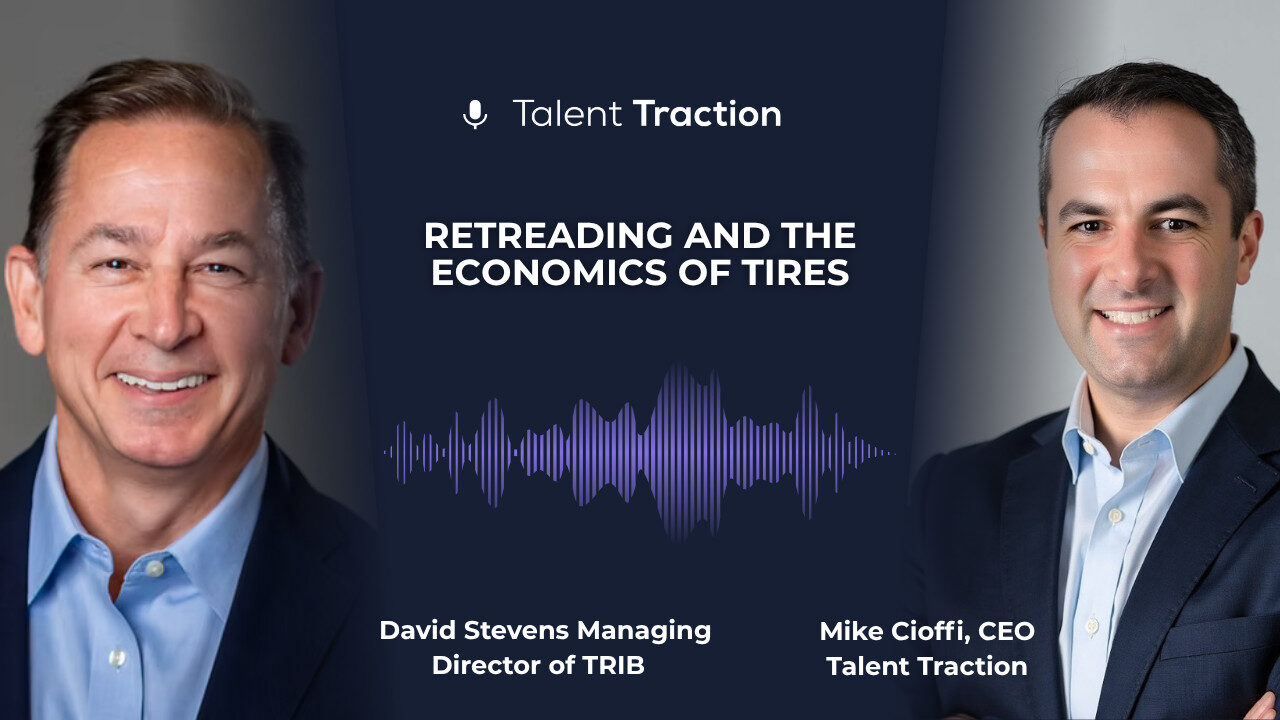
In this episode of the Talent Traction Podcast, Mike Cioffi sits down with David Stevens, Managing Director of the Tire Retread & Repair Information Bureau (TRIB), to unpack one of the most misunderstood — and economically important — parts of the commercial tire industry.
For decades, retreading has battled misconceptions around safety, quality, and performance. But according to Stevens, the reality is very different.
In fact:
- Most major fleets rely heavily on retreads
- Tier 1 commercial tires are specifically engineered to be retreaded
- Retreading dramatically lowers total cost of ownership
- And the process itself has become increasingly advanced through automation and AI
The conversation around retreading and the economics of tires isn’t just about saving money anymore.
It’s about:
- Supply chain resilience
- Sustainability
- Manufacturing economics
- Fleet profitability
- And operational efficiency
The Biggest Misconception About Retreading
According to Stevens, the largest misunderstanding is simple:
👉 Most people don’t realize how advanced retreading actually is.
At trade shows, TRIB regularly conducts a “Spot the Retread” challenge where attendees compare new tires and retreaded tires side by side.
The result?
👉 Roughly 84% of participants cannot tell the difference between a new tire and a retreaded tire.
That moment becomes an opportunity to educate customers about:
- Quality control
- Manufacturing standards
- Inspection technology
- And the engineering behind commercial tire casings
As Stevens explains, many consumers still believe retreading simply means “gluing tread onto an old tire.”
The reality is far more sophisticated.
Commercial Tires Are Built to Be Retreaded
One of the most important insights from the discussion is that Tier 1 commercial truck tires are specifically engineered for multiple lives.
Manufacturers invest heavily into:
- Steel belt construction
- Casing durability
- Structural integrity
Why?
Because the casing itself holds enormous long-term value.
Stevens explains that premium commercial truck tires are often designed to be retreaded:
- One time
- Two times
- Sometimes even more
That changes the economics entirely.
Instead of treating a tire as a one-time purchase, fleets view it as:
👉 A reusable performance asset.
Why Fleets Continue to Bet on Retreads
One of the strongest arguments for retreading is simple economics.
According to Stevens:
- Retreaded truck tires typically cost 30–50% less than comparable new tires
- While still delivering strong performance, reliability, and safety
And the market behavior reflects that reality.
👉 About 90% of fleets with 100+ trucks use retreads in their operations.
That includes:
- FedEx
- UPS
- Large logistics providers
- Major transportation fleets
These are businesses where:
- Downtime matters
- Safety matters
- Delivery performance matters
And they continue choosing retreads because they lower total operating costs without sacrificing reliability.
The Hidden Problem With Cheap Tires
One of the most interesting parts of the conversation centered around low-cost Tier 3 and Tier 4 imported tires.
Stevens argues these products create a major long-term issue for fleets.
Why?
Because many of them:
- Cannot be effectively retreaded
- Wear out faster
- Deliver lower casing quality
- End up entering the waste stream sooner
To the average buyer, these tires may look identical.
But internally, the construction can be dramatically different.
Stevens explains that when some lower-tier casings are examined:
- Belt packages are weaker
- Structural consistency varies
- Buffing surfaces become uneven
- Retread viability disappears
The result:
👉 Fleets may save money upfront, but lose significantly over the full lifecycle.
Retreading Is Also a Sustainability Story
The economics matter.
But sustainability is becoming equally important.
Each retreaded commercial truck tire saves roughly:
👉 15 gallons of oil compared to manufacturing a new tire.
That matters in an environment where:
- Oil prices remain volatile
- Supply chains are strained
- Fleets face ESG pressure
- Sustainability targets are becoming public commitments
Retreading allows fleets to:
- Reduce waste
- Extend tire life cycles
- Lower material consumption
- Improve environmental performance
And increasingly, that sustainability story is becoming part of the sales process itself.
Retreading Helps Protect the Supply Chain
Another major point Stevens raises is supply chain resilience.
During COVID-era disruptions:
- Ports slowed down
- Imports became inconsistent
- Commercial tire supply tightened
Retreading helped fleets continue operating because existing tire casings could be reused rather than replaced.
That creates a strategic advantage:
👉 Retreading reduces dependence on global manufacturing disruptions.
And because the industry supports nearly:
👉 270,000 direct and indirect U.S. jobs, it also represents a meaningful domestic manufacturing ecosystem.
AI and Automation Are Entering Retread Plants
Like much of the tire industry, retreading is beginning to integrate:
- Automation
- Data analytics
- Artificial intelligence
One example Stevens discusses is shearography — advanced inspection systems that act like giant X-ray machines for tire casings.
These systems identify:
- Structural weaknesses
- Internal damage
- Quality concerns invisible to the naked eye
Now AI is being layered into those processes to:
- Improve inspection consistency
- Reduce operator error
- Increase plant productivity
- Maintain quality standards
The industry is also exploring broader automation opportunities inside retread plants to improve:
- Labor efficiency
- Production consistency
- Worker safety
The Industry Is Evolving Beyond Selling Tires
Perhaps the most important long-term shift is that tire dealers are no longer simply selling tires.
They are increasingly selling:
- Tire management programs
- Retreading services
- Repairs
- Fleet data analytics
- Lifecycle optimization
As Stevens explains, the future of retreading is tied directly to:
👉 Data-driven fleet management.
The ability to track:
- Tire wear
- Service intervals
- Retread cycles
- Performance metrics
Will increasingly determine profitability for fleets.
Why the Industry Still Faces a Talent Problem
Despite all the technology improvements, labor remains a major challenge.
Stevens notes that retread plants — like much of the tire industry — continue struggling with:
- Hiring
- Training
- Retention
Which is why automation matters.
Not necessarily to replace workers —
but to:
- Improve productivity
- Reduce repetitive labor
- Help existing teams perform at higher levels