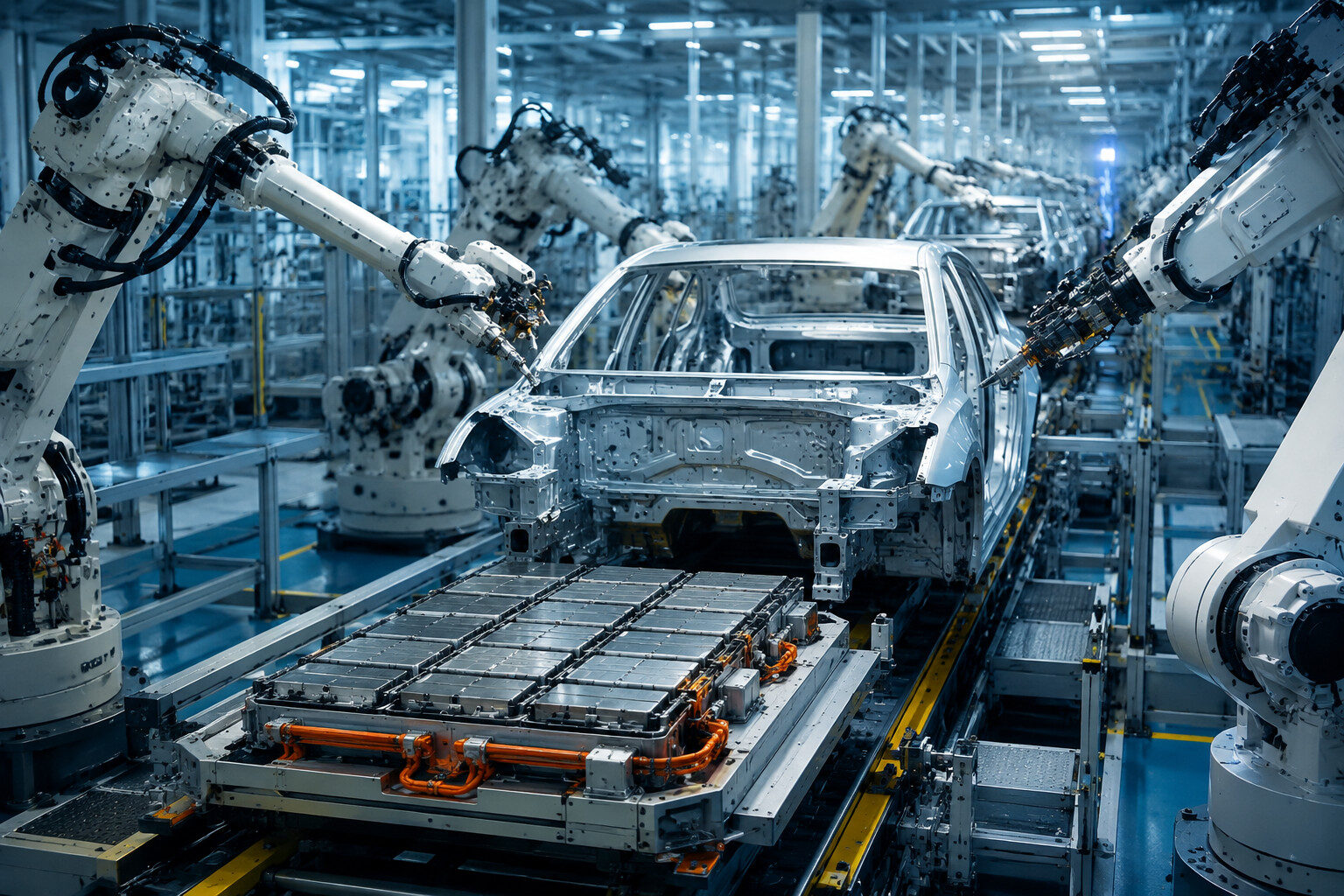
Since the Inflation Reduction Act passed in 2022, U.S. manufacturers have announced more than $125 billion in electric vehicle and battery manufacturing investments. Gigafactories are being built across a stretch of states now called the Battery Belt — Georgia, Tennessee, Kentucky, Ohio, Indiana, Michigan, and the Carolinas. The capital is committed. The facilities are going up. The production timelines are set.
The workforce to run them is not ready.
By 2030, the lithium-ion battery supply chain alone will need 310,000 workers. The IRA is projected to create more than 118,000 new direct jobs across the vehicle, battery, and charging industries between 2026 and 2030. But in a Center for Automotive Research survey, more than 80% of employers in battery-related industries reported shortages of skilled local candidates. Michigan launched a $5 million pilot program to train 2,000 workers for EV and battery technician roles by the end of 2026. Only 220 students enrolled.
The investment is real. The factories are real. The workforce gap between the two is also real — and it is the central operational challenge for every manufacturer trying to staff an EV facility right now.
What EV Manufacturing Actually Requires
The challenge is not simply that there aren’t enough workers. It’s that the specific combination of skills EV manufacturing requires doesn’t exist at scale in the current workforce.
Battery production is not conventional automotive assembly. It’s not conventional electronics manufacturing either. It sits at the intersection of electrochemistry, high-precision manufacturing, and automated systems integration — a combination that most workers in adjacent industries have only parts of.
A cell manufacturing technician at a battery gigafactory needs to understand electrode coating, electrolyte chemistry, formation cycling, and the quality control protocols specific to lithium-ion cell production. A maintenance technician needs to manage complex automated equipment in a controlled dry room environment — with the electrical skills to handle high-voltage battery systems safely and the mechanical skills to maintain precision equipment running around them. A quality engineer needs to hold IATF 16949 knowledge while learning an entirely new set of product specifications.
None of these skill profiles exist in large numbers in any regional labor market. They are being built from scratch at every new facility, which means every gigafactory is essentially in the same race: training a workforce while trying to hit production targets, with a pool of candidates that was never designed to feed this specific industry.
The Hardest Roles to Fill
Across EV manufacturing facilities currently ramping, four role categories are consistently generating the longest searches and the highest failure rates.
Battery cell and module engineers. The combination of electrochemistry knowledge and manufacturing process experience is rare. Most electrochemists come from academic or research backgrounds and lack production floor credibility. Most manufacturing engineers lack the chemistry depth. The candidates who have both are extremely few, extremely in demand, and carry price tags — $115,000 average battery engineer salary in 2026 — that legacy manufacturing facilities weren’t budgeting for.
Automation and controls technicians. EV battery manufacturing runs on sophisticated automated equipment: electrode calendering lines, laser notching systems, stacking or winding machines, formation cyclers. The technicians who can maintain and troubleshoot this equipment need PLC proficiency, electrical systems knowledge, and precision mechanical skills. This skill set is in shortage across all advanced manufacturing — which means EV facilities are competing for the same automation technicians that every other modern factory in the region also needs.
Quality engineers with automotive and battery experience. Quality professionals who understand IATF 16949, have managed an automotive customer base, and can also navigate battery-specific quality requirements — capacity testing, cycle life, safety and abuse testing protocols — are extraordinarily difficult to find. The conventional automotive quality pipeline doesn’t produce them because the product requirements are different. The battery research pipeline doesn’t produce them because the manufacturing interface requirements are different.
Dry room and process technicians. Lithium-ion cell manufacturing requires dry room environments with controlled humidity below 1% RH. Working in these environments long-term is physically demanding and requires specific safety training. Finding technicians willing and able to work in dry rooms consistently — and training them to the process standards required — is one of the most underestimated staffing challenges in battery manufacturing.
The Geographic Problem Compounds Everything
Most major EV battery facilities are being built in regions without deep manufacturing talent pools for the specific roles they need. The Battery Belt’s appeal — land availability, incentive packages, proximity to automotive OEM customers — doesn’t come with a ready workforce.
Panasonic’s Kansas facility, SK On’s Georgia plants, Blue Oval City in Tennessee, the LG Energy Solution facilities in Michigan and Arizona — these are in labor markets where the chemical manufacturing, precision electronics, and high-voltage systems talent these facilities need simply doesn’t exist in large numbers. The workforce has to be built. And building it takes years, not quarters.
This creates a compounding problem: facilities are being built faster than the training pipelines can produce qualified workers. Every gigafactory is in the same race — training a workforce while hitting production targets, while competitors are actively trying to hire that same workforce away.
What Employers Are Getting Right — and Wrong
The EV manufacturers who are staffing effectively are doing something that most traditional manufacturers resist: hiring for aptitude and attitude, then building the domain knowledge themselves.
A battery cell technician role that requires “3 years of lithium-ion cell production experience” will produce a short candidate list and a long search in almost every region. A battery cell technician role that requires demonstrated precision manufacturing experience, a strong safety record, and the aptitude to learn battery-specific processes will produce more candidates — and facilities with structured internal training can close the knowledge gap within six to twelve months.
The employers getting this wrong are treating EV manufacturing as a plug-and-play hiring exercise — posting job descriptions, screening for credentials that don’t exist at scale, waiting for candidates who match a profile the industry hasn’t had time to produce in volume, and wondering why the search is six months old with no offer made.
The IRA tax credits that drove the investment wave require domestic production. That means the workforce has to be built here, from what’s available here — which is a large pool of workers with adjacent skills and the capacity to learn, and a small pool who already know exactly what a gigafactory needs. The employers building robust internal training programs around the first group are staffing their facilities. The ones waiting for the second group are falling behind schedule.
What This Means for Industrial Employers Broadly
Even manufacturers not directly in the EV supply chain are feeling the effects of this talent competition. The automation technicians, electrical engineers, quality professionals, and maintenance specialists that EV facilities are recruiting aggressively are the same candidates that plastics, rubber, chemical, and industrial equipment manufacturers have been trying to hire for years.
The Battery Belt’s workforce demand is pulling talent toward EV roles — often at salary levels that industrial manufacturers haven’t historically needed to match. Understanding that competitive pressure is the first step to responding to it. Competing with it means investing in employer brand, compensation benchmarking, internal development, and sourcing strategies that reach beyond the standard job board pool.
The EV manufacturing boom is real. The workforce problem is real. For every industrial manufacturer in its path — whether building batteries or competing for the same people who are — the right response is to act now rather than wait for conditions to ease.
For industrial and manufacturing employers navigating EV-era talent competition: Connect with the Talent Traction team to discuss how your recruiting strategy is positioned against a labor market that’s changing faster than most hiring plans anticipated.
For engineers, technicians, and manufacturing professionals exploring EV opportunities: Reach out to Talent Traction to confidentially explore what the EV manufacturing sector currently offers for your background.