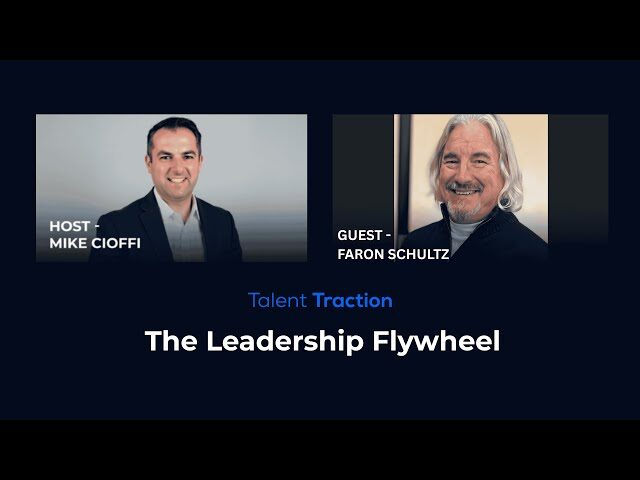
In this episode of The Talent Traction Podcast, Mike Cioffi sits down with Faron Schultz, a retired executive leader from Les Schwab Tire Centers, to talk about what leadership really looks like inside a large, values-driven organization and why the best companies win through culture, discipline, and people development even as the market changes around them.
Faron brings five decades of perspective, starting with selling his first set of tires in 1976, then joining Les Schwab in the late 1980s and spending more than half his life inside one of the industry’s most respected legacy brands. The conversation isn’t built around hacks or tactics. It’s about the compounding effect of leadership over time.
Because in a mature, competitive industry, the biggest advantage isn’t a new program. It’s the ability to consistently motivate people to do the right things especially when nobody is watching.
Leadership that lasts starts with passion
Faron’s definition of leadership is straightforward: great leaders ignite passion and aspiration.
Early in a career, an individual can create success with their own two hands and one brain. But the ceiling is obvious. The real scale comes when a leader can inspire the hands and brains of others to build something bigger than any one person can accomplish alone.
What changes over time isn’t the need for inspiration it’s where it has to come from.
The tire industry is experiencing an ongoing shift from founder-led organizations to second- and third-generation leadership. Faron points out that leadership doesn’t live in a founder’s personality. It lives in the leaders who carry the torch forward.
That’s important, because ownership can change. Markets can change. Business models can change.
But people still follow people.
And when leadership forgets that when motivation gets replaced by cash flow obsession you don’t just lose culture. You lose performance.
The real growth engine is “leaders in the store”
One of the most practical parts of the conversation is Faron’s explanation of expansion.
When a tire company opens a store in a new market, the reality is harsh: nobody asked for you to show up. The day your store opens, people already have a tire guy. The market doesn’t need another option. It needs a better one.
So what makes the difference?
Faron’s answer is simple: a leader goes into that store.
That’s why the best operators promote from within. It’s why stores can succeed 1,500 miles away from headquarters. It’s why some acquisitions stall when legacy management is kept in place without the same training, standards, and leadership expectations.
The flywheel starts when a strong leader builds:
- customer care discipline
- team accountability
- pride in the work
- an identity bigger than the paycheck
That’s what creates local momentum. And momentum is what makes a new store “talked about” in a town.
Culture isn’t built at the top
Culture starts at the top but it’s not built there.
Faron frames it in a way leaders of distributed teams should sit with: culture is built in the middle.
The executive team might be five or ten people. The middle of the organization is where culture lives day-to-day store managers, assistant managers, frontline leaders. They’re the ones translating values into behavior.
And culture shows up in small moments.
Faron says he shops tire stores as a hobby dozens every year and you can feel culture immediately. It’s black and white. Pull in and ask for an air check:
- Do they come out quickly?
- Do they act like they care?
- Do they replace a missing valve cap?
- Do they pay attention to safety or just go through motions?
If a culture has to be explained, it’s probably not alive. Real culture is a feeling built through consistent actions and consistent “why.”
Operational excellence is a thousand small details
One of the strongest themes in the episode is how small operational disciplines compound into long-term results.
Faron describes the scale: on some days, Les Schwab teams worked on thousands of vehicles. Those vehicles back out of a bay and can be on the freeway at 80 mph within minutes. You’re the last person to touch it.
That changes what details mean.
Suddenly, torque specs aren’t just processes; they’re safe. Communication isn’t just politeness, it’s trust. Documentation isn’t just a system, it’s accountability.
Faron’s principle becomes the anchor:
“This is how we do it here.”
Not as rigidity. As discipline.
Because once you define “how we do it here” and “why we do it here,” you create a baseline. From there, you can improve. You can optimize. You can evolve. But you can’t evolve what you don’t standardize.
Gen Z doesn’t “not want to work” they want meaning
Mike pushes into talent attraction, especially Gen Z. Faron challenges the lazy narrative that “young people don’t want to work.”
His view: many young people haven’t been shown why the work matters.
The average kid today gets their driver’s license later. They didn’t grow up in the garage. Cars aren’t automatically interesting. The work has to be taught and more importantly, the why has to be taught.
Why balance matters.
Why rotation matters.
Why the customer’s safety depends on the details.
When young talent understands meaning, aspiration becomes possible. When they don’t, it’s “just a job.” And “just a job” is where turnover lives.
This is where the leadership flywheel connects directly to retention: leaders who explain the why don’t just improve performance they keep people longer.
Disruption risk: using AI in the wrong places
Faron isn’t anti-technology. He’s cautious about replacing the most valuable asset in the business: the relationship.
He shares a simple point that every tire operator can relate to: if you’re going to insert AI between you and a customer, it needs to be exceptional. Not “good enough.” Not “better than a phone tree.” It needs to work.
Because the tire business is still built on trust and service whether you’re retail, wholesale, manufacturing, or logistics.
At the same time, AI is becoming necessary for complexity management. With hundreds of tire sizes, seasonal shifts, good-better-best strategies, winter/all-weather variations, and rolling resistance demands, the industry can’t rely on spreadsheets forever.
The disruption won’t be AI itself. It will be:
- adopting too early
- adopting in the wrong areas
- replacing relationships instead of enhancing them
Consolidation will continue but leadership determines outcomes
Mike asks the question many owners are asking: will independents be swallowed? Will the market consolidate into a few giants?
Faron’s take is balanced:
- It will always be relatively easy to start a tire shop tools, equipment, distribution access.
- The 20–30 store operator without a succession plan becomes a target.
- Ownership can change without destroying a business… if leadership stays strong.
He gives a blunt reality: ownership changes can create a great company or ruin it. The deciding factor isn’t the capital structure. It’s whether leadership still motivates people to build great products, install them correctly, and protect customer trust.
Retention lesson: transparency and shared upside
One of the most tactical parts of the conversation comes late: retention.
Faron points to Les Schwab’s historic strength in profit sharing and transparency. Employees could see performance. They understood how the store did and how that translated into rewards including retirement.
It wasn’t spiffs or short-term incentives. It was long-term alignment.
And it reinforced the flywheel: when people share in success, they care more. When they care more, customers feel it. When customers feel it, the business grows.
The flywheel, summarized
If you wanted to turn this conversation into a simple model, it looks like this:
Purpose → Standards → Accountability → Trust → Loyalty → Growth → Profitability → Investment back into people → More purpose
That’s the leadership flywheel.
And it’s why the best tire organizations don’t just survive cycles. They compound through them.