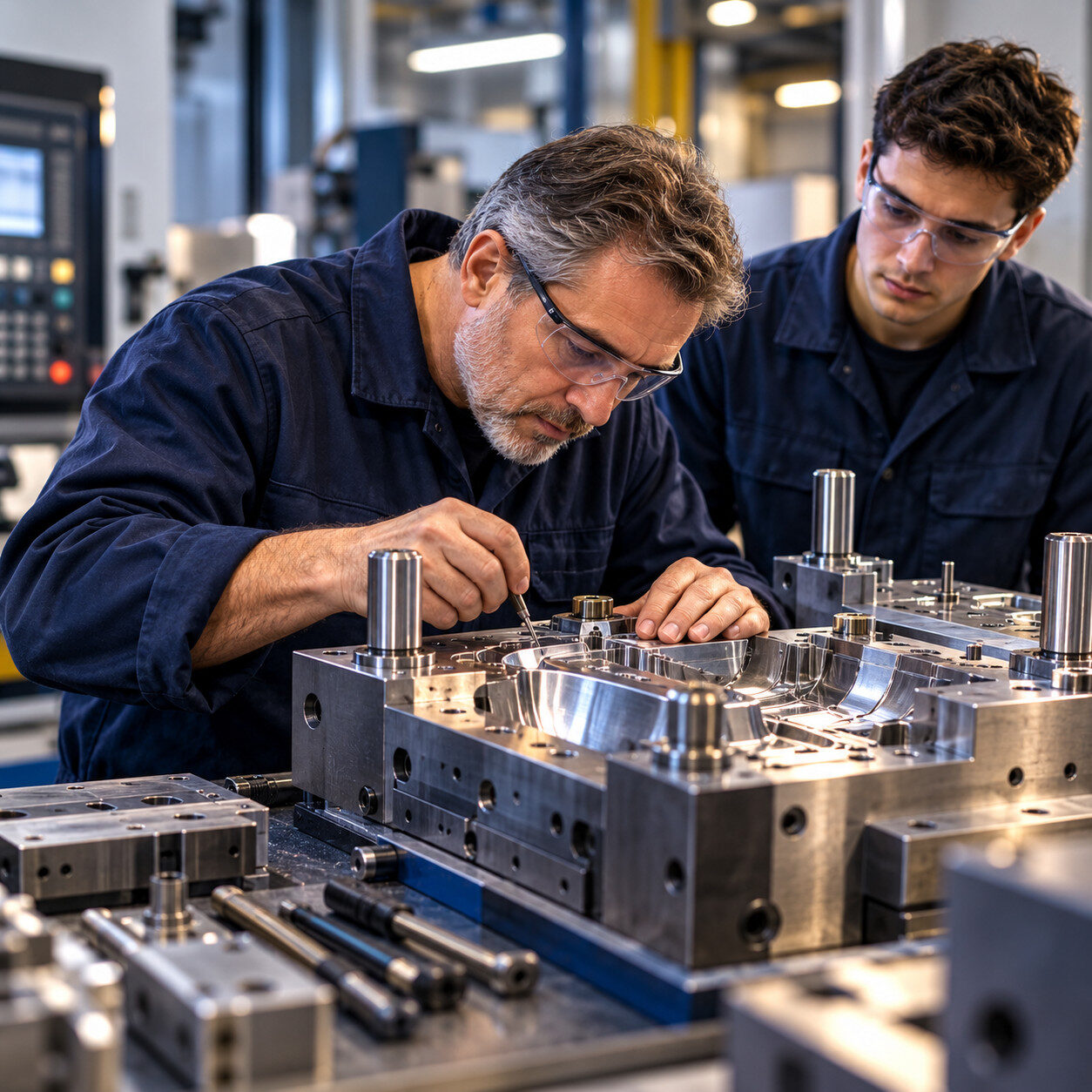
The CNC machinist career path is one of the strongest technical career tracks in American manufacturing right now — and one of the least publicized. While employers across aerospace, automotive, defense, and medical device manufacturing are posting record numbers of machinist openings, most people considering a skilled trades career have only a vague sense of where the CNC machinist career path actually leads, what it pays at each level, and what it takes to advance beyond entry-level operator work.
This guide answers those questions directly. Whether you’re starting from zero, currently running machines, or deciding whether to make the investment in programming skills, what follows is a level-by-level breakdown of the CNC machinist career path in 2026 — with real salary data, the specific skills that move the needle, and an honest account of what the manufacturing skills gap means for anyone building a career in this field.
What CNC Machinists Actually Do
CNC machinists operate computer-controlled cutting machines — mills, lathes, turning centers, grinders, and multi-axis machining centers — to produce precision metal components to exact specifications. The work involves reading blueprints and technical drawings, setting up and loading material, writing or editing G-code programs that control machine movement, monitoring the machining process, measuring finished parts with precision instruments, and adjusting setups when parts fall out of tolerance.
The range of what a CNC machinist touches varies enormously by employer. A machinist at an aerospace subcontractor might spend an entire week setting up and running one complex titanium component with tolerances measured in ten-thousandths of an inch. A machinist at a high-volume automotive supplier might run a cell of machines producing thousands of identical parts per shift. Medical device machinists work with implant-grade materials in cleanroom-adjacent environments with documentation requirements that would be unrecognizable on a job shop floor.
This variety is part of what makes the CNC machinist career path durable. The same foundational skill set — precision measurement, blueprint reading, setup discipline, machine knowledge — applies across industries, which means machinists who develop that foundation have genuine mobility across sectors.
Getting In: What Entry Actually Requires
The CNC machinist career path does not require a four-year degree. The practical entry routes are a 6-to-24-month vocational or community college program, a paid apprenticeship (typically 3–4 years, earning wages while learning), or direct on-the-job training from an employer willing to develop entry-level talent.
Most employers look for a high school diploma or equivalent, mechanical aptitude, basic math through algebra and geometry (trigonometry becomes useful quickly), and the ability to read a blueprint or the willingness to learn. Machine operation experience from any manufacturing environment is a meaningful credential at the entry level, even if the machines weren’t CNC.
The industry is actively competing for early-career talent right now. Over 50% of manufacturers report difficulty hiring qualified CNC operators (The Manufacturing Institute, 2025), and 26% of the current manufacturing workforce is approaching retirement age. That competition means training programs exist, paid apprenticeships are available, and employers who were once rigid about experience requirements have become substantially more flexible. This is an unusually good moment to enter the trade.
The CNC Machinist Career Ladder: Level by Level
Level 1: CNC Machine Operator ($39,200–$47,000)
The entry point on the CNC machinist career path is machine operation — loading and unloading parts, running programs that someone else wrote, performing in-process inspection using calipers, micrometers, and gauges, and flagging issues to a setup tech or supervisor.
At this level, the job is primarily about learning the rhythms of a production floor: what good parts look and feel like, how to catch a tool wear pattern before it produces scrap, what the machine sounds like when something is wrong. These are not skills you can learn in a classroom. They come from time on the machine, attention to what’s happening, and the habit of asking questions rather than guessing.
Entry operators at the 10th percentile nationally earn approximately $39,200 (Bureau of Labor Statistics, May 2025). Within 12–18 months of consistent work and demonstrated attention to quality, that number moves. Operators who show setup aptitude — who watch the senior machinists closely and ask to be taught — make the jump to the next level faster than their peers.
Level 2: CNC Machinist ($52,000–$62,000)
The step from operator to machinist is the most significant transition on the CNC machinist career path. A machinist doesn’t just run programs — they set up the machine. That means selecting and installing tooling, locating and securing the workpiece, editing programs to make adjustments, understanding why a tool path is designed the way it is, and troubleshooting when a dimension is drifting.
Setup responsibility is where the real education happens. Every setup is a problem-solving exercise: material behavior, tooling selection, fixturing stability, feeds-and-speeds relationships, and surface finish requirements all interact in ways that no set of classroom notes fully prepares you for. The machinists who learn to set up machines well are the ones with options.
The national median annual salary for machinists at this level is $58,750 ($28.24/hour), per Bureau of Labor Statistics OEWS data from May 2025. The 25th percentile earns approximately $47,000; the 75th percentile is around $67,700.
Level 3: Setup Machinist / Senior CNC Machinist ($65,000–$75,000)
Senior machinists and setup specialists carry the most difficult equipment and the most complex parts. They’re the person the shop calls when a new job is ready to launch, when a first-article inspection needs to pass, or when a production problem that has stumped two other techs needs a fresh set of eyes.
At this level, multi-axis experience — particularly 4-axis and 5-axis machining — separates high earners from the median. A senior machinist who can set up and run a 5-axis machining center competently is a genuinely scarce resource in most regional manufacturing markets. Shops need them, they know it, and the compensation reflects it.
GD&T (Geometric Dimensioning and Tolerancing) fluency becomes important at this level. Machinists who can read a GD&T callout, understand what it’s actually controlling, and know how to measure and document conformance are more valuable than those who read conventional tolerances only.
Level 4: CNC Programmer ($69,880–$99,000+)
CNC programming is where the CNC machinist career path offers its biggest salary jump. Programmers write and optimize the G-code — or, more commonly in 2026, use CAM software to generate and refine toolpaths — that tells the machine exactly what to do. They work from engineering models and drawings to produce programs that make good parts efficiently, with the right tooling, in the right sequence.
BLS data for CNC Tool Programmers (SOC 51-9162) shows a median salary of $69,880, a 75th percentile of $83,650, and a 90th percentile of $99,060 (May 2024). Programmers who also set up and run the machines they program — closing the loop between digital and physical — are at the top of that range and command strong demand from shops trying to reduce the translation losses between programming and production.
The software proficiency that matters most in 2026: Mastercam, Fusion 360 CAM, Siemens NX CAM, VERICUT for simulation, and familiarity with at least two major CNC control systems (Fanuc, Heidenhain, Mazak Mazatrol, Siemens Sinumerik). Programmers who can work across control systems have substantially more mobility than those locked into one.
Level 5: Manufacturing Engineer / Applications Engineer ($90,000–$130,000+)
The top of the CNC machinist career path, for those who want to stay technical rather than move into management, runs through manufacturing engineering and applications engineering roles. Manufacturing engineers own the process — from design for manufacturability review through tooling strategy, process documentation, and continuous improvement. Applications engineers at tooling and machine tool manufacturers apply deep machining expertise to help customers get better results from equipment and cutting tools.
These roles regularly reach $90,000 to $130,000 and above at major manufacturers and Tier 1 suppliers. They require the combination of hands-on machining expertise, programming capability, and the broader engineering systems thinking that comes from years of exposure to what works and what doesn’t on real production floors.
Which Industries Pay CNC Machinists the Most?
Industry matters as much as level on the CNC machinist career path. BLS OEWS data shows clear pay variation by sector:
Transportation equipment manufacturing pays the highest median for machinists at $60,300/year — driven by aerospace and automotive OEM and Tier 1 work with strict quality requirements.
Machinery manufacturing pays a median of $56,200, with strong demand from industrial equipment, agriculture, and energy sectors.
Fabricated metal product manufacturing pays a median of approximately $51,000 — entry-level for the sector, but a large employer of machinists nationally.
Aerospace component manufacturing and defense consistently sit at the top of the range for experienced machinists and programmers, particularly for work requiring ITAR compliance, AS9100 quality systems, and exotic material experience (titanium, Inconel, hardened steels). Programmers and senior machinists in these environments regularly exceed $85,000–$95,000.
Medical device manufacturing is the other premium sector — tight tolerances, implant-grade materials, and FDA-regulated documentation requirements make experienced machinists in this space difficult to find and highly compensated.
The Skills That Drive Advancement Most Reliably
The CNC machinist career path rewards specific skill investments more than seniority or time served. These are the capabilities that separate machinists who advance quickly from those who plateau.
CAM software proficiency is the most direct path to a salary increase. A machinist who can write and optimize programs in Mastercam or Fusion 360 CAM has moved into programmer territory in terms of compensation, regardless of their job title. Employers regularly pay programmers $15,000–$25,000 more per year than pure setup machinists at equivalent experience levels.
Multi-axis machining — particularly 5-axis simultaneous contouring — is a skill gap in most regional manufacturing markets. Machinists who invest in understanding 5-axis geometry, workholding for 5-axis work, and the programming considerations specific to simultaneous cutting are entering a small talent pool with strong demand.
Metrology and quality systems knowledge adds value at every level. Understanding GD&T, operating CMM (coordinate measuring machine) equipment, and working within ISO 9001 or AS9100 quality management frameworks makes machinists more useful to employers and opens doors into quality engineering and inspection supervisor roles alongside the traditional machining progression.
Control system breadth is underestimated. Machinists who have worked on both Fanuc and Heidenhain controls — who understand how the same G-code concept is expressed differently across platforms — are more deployable across customers and job types, and employers pay a premium for that flexibility.
What the CNC Machinist Shortage Means for Your Career
The numbers behind the shortage define what the CNC machinist career path offers in 2026 in concrete terms.
The Bureau of Labor Statistics projects approximately 34,200 machinist and tool-and-die maker openings per year through 2034 — almost entirely driven by retirement, not industry decline. Roughly 70% of the current machinist workforce is over 45, with the median age of CNC operators now sitting at 55 (Manufacturing Institute, 2025). Within the next decade, a substantial portion of the most experienced machinists in the country will have left the workforce.
Deloitte and the Manufacturing Institute project that 2.1 million manufacturing jobs could go unfilled by 2030 if the skills gap continues at its current trajectory. As of December 2025, there were 433,000 open manufacturing jobs in the U.S. The gap between demand and available talent is not narrowing.
For someone building a CNC machinist career, this is a structural advantage. The people who develop genuine setup and programming capability in the next two to three years are entering a market where their skills will be scarce and the employers who need those skills are competing for them. The negotiating dynamics at the offer stage, the compensation trajectory, and the employment security all reflect a market where qualified machinists have options.
What This Means for Manufacturing Employers
The CNC machinist shortage is not a hiring problem that better job postings will solve. The experienced machinist who already programs 5-axis equipment and knows your material is employed, not on job boards, and likely not leaving for $2 more an hour.
The employers who are successfully staffing machinist roles in 2026 are doing a few things that distinguish them from those perpetually re-posting the same opening. They hire machine operators with aptitude and build machinists internally, with structured training paths and time commitments that give candidates a reason to stay through the development period. They partner with community college machining programs before graduation — not to post entry-level jobs but to build relationships and hire co-op students who already know the shop. They benchmark compensation against the market annually, not when someone resigns. And they move fast at the offer stage: a qualified machinist with multiple interests cannot wait three weeks while a hiring committee convenes.
Talent Traction’s industrial recruiting team specializes in active sourcing for precision manufacturing roles — including CNC machinist, programmer, and manufacturing engineer positions where passive candidates are the only viable pool.
Frequently Asked Questions
How long does it take to become a CNC machinist?
Most people become employable as CNC machine operators within 6 to 12 months of vocational training or on-the-job experience. Reaching full machinist level — where you can set up machines independently and troubleshoot setups — typically takes 2 to 4 years of hands-on work. A paid apprenticeship, which combines structured instruction with supervised floor experience, usually runs 3 to 4 years and is one of the fastest paths to senior-level capability.
Do you need a degree to become a CNC machinist?
No four-year degree is required. The vast majority of CNC machinists enter through a community college technical program (6 months to 2 years), a paid apprenticeship, or direct employer training. Practical skills, certifications, and demonstrated machine experience carry significantly more weight with employers than a traditional degree. Relevant certifications include NIMS (National Institute for Metalworking Skills) credentials, which are recognized across manufacturing industries and signal verified competency at each level.
Is CNC machining a good career in 2026?
Yes — and the structural argument is stronger now than it has been in decades. The BLS projects 34,200 machinist openings per year through 2034 (Bureau of Labor Statistics, 2024), driven almost entirely by retirement rather than industry decline. The median salary of $58,750 is above the U.S. median wage for all occupations, the advanced tiers reach $80,000–$99,000+, and the shortage of qualified candidates means machinists with genuine programming and setup skills have strong negotiating leverage. Automation is increasing demand for machinists who can program and maintain complex equipment, not eliminating the role.
What is the difference between a CNC machinist and a CNC programmer?
A CNC machinist sets up and runs CNC equipment — installing tooling, loading material, proving out programs on the machine, and producing parts to specification. A CNC programmer writes or generates the code that tells the machine what to do, typically working from CAD models and engineering drawings using CAM software. In practice, the distinction is blurry: the best programmers are machinists who understand what happens when the program runs, and the most capable senior machinists write and edit programs routinely. Programmers typically earn $10,000–$25,000 more per year than setup machinists at equivalent experience levels, which makes programming proficiency the highest-return skill investment on the CNC machinist career path.
The Bottom Line
The CNC machinist career path offers something increasingly rare in 2026: a genuine technical career with a clear earnings ladder, strong employer demand at every level, no degree requirement, and structural tailwinds from retirement and reshoring that will persist for the next decade. The entry is accessible. The ceiling — for machinists who invest in programming and multi-axis skills — reaches into six figures. And the people who do this work well are in shorter supply every year.
Whether you’re deciding how to enter the field, which skills to build next, or what the market currently offers for your experience level, the path from operator to programmer to senior engineer is one of the most reliable technical career tracks in American manufacturing.
For industrial and manufacturing employers with open CNC machinist or programmer roles: connect with the Talent Traction recruiting team to discuss active sourcing strategies for precision machining candidates — including passive candidates not reachable through job boards.
For CNC machinists and programmers exploring what the current market offers for your experience level: reach out to Talent Traction to confidentially explore opportunities at employers building serious machining operations.