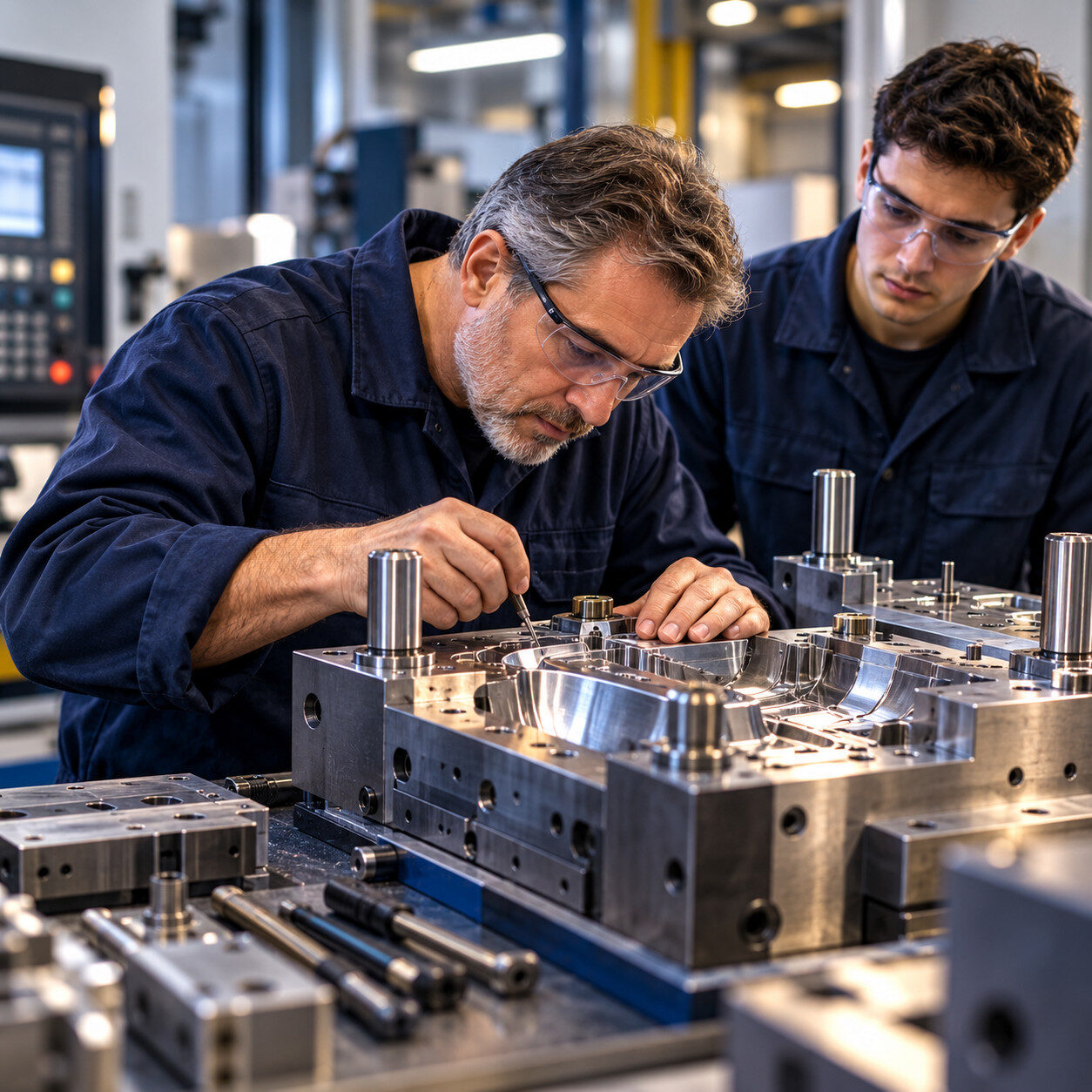
The moldmaker shortage gets filed under workforce development, alongside every other skilled trades gap in manufacturing. That filing understates it. When a mold shop cannot replace a retiring toolmaker, the capability does not move to a competitor across town. It leaves the country.
And the thing that leaves with it is not the price of a mold. Offshore tooling is cheaper and has been for twenty years. What leaves is response time — the ability to get a design change actioned in days instead of weeks, and that is the one advantage domestic tooling has.
The demographics behind this are not speculative. According to American Mold Builders Association data, 70% of employees inside US mold-building facilities were under 50 in 2006. Today only 57% are, a new industry low. Just over four in ten people in the mold room are now 50 or older.
A registered tool and die apprenticeship runs four years, roughly 8,000 hours. Which means replacing someone who retires in 2030 requires starting them in 2026. The arithmetic is unforgiving and almost nobody is doing it.
The Statistic That Confuses Employers
There is a genuine paradox in the public data on this trade, and it causes real harm because it leads employers to deprioritize the pipeline.
The Bureau of Labor Statistics projects employment for machinists and tool and die makers to decline about 2% between 2024 and 2034. Read that line alone and the conclusion is obvious: a shrinking trade, not worth investing in.
The next line matters more. BLS also projects roughly 34,200 openings every year across that occupational group, essentially all of them arising from workers retiring or leaving the occupation.
So the occupation is contracting and hiring desperately at the same time. Total employment drifts down while the replacement demand runs at tens of thousands a year, because the people leaving outnumber the people entering by a wide margin. A shop that reads “declining occupation” and decides not to run an apprenticeship is responding to the wrong number.
Why a CNC Machinist Is Not a Moldmaker
This distinction is the reason the moldmaker shortage cannot be solved by hiring from the broader machining pool, and it is worth being specific about, because job postings routinely conflate the two.
A good CNC machinist can run a mill, hold a tolerance, read a print, and produce a part to specification. All of that is necessary for moldmaking and none of it is sufficient.
Building a mold requires understanding how tool steel behaves — P20 versus H13 versus S7, what hardening does to dimensions, where EDM is the only option. It requires designing cooling lines whose placement determines cycle time and whether the part warps. It requires predicting shrinkage by resin, which varies by material, wall thickness, and fill pattern. It requires gate, runner, and venting decisions that determine whether the tool fills properly at all. It requires slides, lifters, and unscrewing cores for geometry that cannot be straight-pulled. It requires polishing and surface finish to a texture specification. And it requires troubleshooting at the press when a tool flashes, short shots, or sinks in production.
Underneath all of that sits the part that takes years: the judgment to know how a mold will behave in production before any steel is cut. That judgment is accumulated from building tools, watching them run, and learning what went wrong. It is not transferable through documentation and it is not a training module.
This is why a mold shop losing its last journeyman toolmaker has lost something it cannot backfill from the local machining market, however many qualified machinists are available.
What Actually Happens When Domestic Tooling Capacity Shrinks
Follow the consequence through, because this is where the problem stops being an HR issue and becomes a strategy issue.
On straight tooling cost, offshore wins and it is not close. Industry estimates put a production mold for a mid-complexity part — four to eight cavities in standard P20 — at roughly $5,000 to $25,000 sourced from China against $15,000 to $80,000 domestically. Depending on the program, offshore tooling runs 30 to 60% below domestic, with larger gaps on part cost for high-volume work.
Tariffs have narrowed that somewhat. Duties on imported steel molds and plastic components currently run between 10 and 25% depending on classification, which raises effective landed cost meaningfully without closing the gap.
Where domestic capability wins is time and iteration. Tooling lead time offshore averages around 30 to 45 days against 45 to 75 days domestically — but add shipping and customs, and mold-to-first-parts runs roughly 6 to 10 weeks domestically versus 14 to 20 weeks overseas. Reorders ship in days rather than crossing an ocean.
The decisive number is what a change costs. A design revision that a domestic toolmaker can action in two to three days takes three to five weeks offshore.
For a program in development, where revisions are expected, that difference compounds across every iteration and determines whether a launch date holds. For an established high-volume program with a frozen design, it barely matters and offshore is the rational choice.
Which is the real strategic point. Domestic mold capacity is not about competing with offshore on price — that competition was lost long ago and is not coming back. It is about retaining the capability to iterate quickly on the programs where speed decides the outcome. When the mold room empties, that option disappears, and every tooling decision becomes an offshore decision with an offshore clock.
Mold Design Is a Second, Separate Pipeline
Worth separating, because shops frequently discover the design gap only after solving the bench gap.
Mold design is its own discipline. It requires fluency in mold-specific CAD — the mold tooling environments in SolidWorks, NX, or Cimatron — plus flow simulation work in Moldflow or equivalent to predict fill, weld lines, air traps, and warpage before steel is committed. It requires knowing standard mold base and component catalogs well enough to design around what is actually available, and it requires enough manufacturing knowledge to design a tool that can be built and maintained rather than one that merely looks correct on screen.
The pipeline here is thinner than the bench pipeline in one specific way: mechanical engineering graduates are not taught mold design, and the people who do it well generally learned it from a senior designer inside a shop. That is the same apprenticeship problem in a different chair, with a smaller pool of practitioners to learn from.
Shops planning a tooling succession should count designers separately from toolmakers. The two are not interchangeable, and losing the only person who can design a tool is as limiting as losing the only person who can build one.
The Compensation Problem the Industry Has to Face
Here is the uncomfortable part, and the association’s own data makes it difficult to argue with.
BLS puts the median annual wage for tool and die makers at $64,050 as of May 2025, with the top 10% above $92,680 and the bottom 10% below $44,680. The AMBA 2025 Wage and Salary Report, drawn from 88 mold manufacturers covering roughly 3,500 employees, found 37 of 53 tracked roles posting year-over-year increases — but with an average gain of just 1.4%, reflecting softer demand through 2025.
Now set that against what the adjacent trades pay. A CNC programmer at the 90th percentile clears $99,000. Controls and automation technicians command premiums across every sector installing automation. Both require substantially less than four years of structured apprenticeship to reach good money.
A trade that demands a four-year apprenticeship, pays a median in the low sixties, and raised wages 1.4% last year is not going to attract the pipeline it needs. That is not a messaging problem or an image problem. It is a pricing problem, and it is the root cause underneath the demographic numbers.
Shops that intend to have toolmakers in 2032 will have to pay against the trades they actually compete with for mechanically capable young people, not against the historical band for moldmaking. That is expensive. It is less expensive than not having a mold room.
What to Do, Concretely
Count your exposure by name and by age. List every toolmaker, their age, their retirement eligibility, and specifically what each one knows that nobody else does — which tools they built, which presses they can troubleshoot, which customers’ programs they understand. Most shops find the real exposure concentrated in two or three people.
Start an apprentice now and accept the four-year math. There is no shortened path. A shop that begins in 2026 has a journeyman around 2030. A shop that waits until the retirement notice arrives is starting four years late. The programs exist and technical school partnerships in precision machining and tooling are frequently undersubscribed, which means capacity is available.
Pair the apprentice with the retiring toolmaker for years, not weeks. The judgment transfers through doing the work alongside someone who has done it, with progressively more of the decisions handed over. A two-week handover at retirement transfers nothing of value.
Price the role against the competing trades. Benchmark against CNC programming and controls work, not against what moldmakers in your region earned five years ago. If the number is uncomfortable, compare it to the cost of a tooling program you can no longer run in-house.
Recruit for aptitude and interest, then train. The candidate pool with mold-building experience is the pool everyone else is failing to hire from. Mechanically capable people with CNC, tool and die, or precision machining backgrounds, or strong aptitude and genuine interest, are the realistic source. Our guidance on hiring plastics talent without plastics experience applies here with one difference: the training runway is longer and needs formal structure.
Decide your hybrid position deliberately. Many shops are landing on offshore tooling for commodity, frozen-design, high-volume programs and retaining domestic capability for development work, fast-iteration programs, and anything where a three-to-five-week change cycle would break the schedule. That is a defensible strategy. Arriving at it by default, because the mold room emptied, is not.
For current pay context across these roles, our plastics industry salary guide and our breakdown of which plastics processes pay the most cover the ranges you will be benchmarking against.
The Case for the Trade, Stated Honestly
Shops struggling to recruit apprentices are often making a weak pitch, because they are selling stability to people who have never considered the trade at all. There is a stronger and more accurate case available.
Start with scarcity. A twenty-two-year-old who completes a tool and die apprenticeship enters a trade where the competition is retiring and the replacements are not arriving. BLS projects roughly 34,200 annual openings in the occupational group against a shrinking workforce. Very few career paths offer that arithmetic.
Then the automation argument, which matters to anyone paying attention to where manufacturing work is going. Mold design judgment and press-side troubleshooting are not tasks software performs. Software has made moldmaking faster — CAD, simulation, high-speed machining, and CMM inspection are all standard now — without reducing the need for the person who decides where the cooling goes and why the part is warping. Automation has changed the tools of this trade considerably and has not replaced the trade.
There is also the nature of the work itself, which is genuinely unusual in modern manufacturing. A toolmaker builds a single object, by hand and by machine, over weeks, that then produces millions of identical parts. The feedback is concrete and the craft is real. For the subset of people who want that, nothing else in a plant offers it.
And the skill is portable. A journeyman toolmaker can work in automotive, medical, packaging, consumer products, or aerospace, in almost any industrial region, and the credential does not expire.
What the pitch has to be honest about is the four years and the pay during them. Candidates can evaluate a four-year investment if someone shows them the progression and what the number looks like at the end. What loses them is a posting that asks for experience the market cannot supply and says nothing about where the role leads.
Frequently Asked Questions
How long does it take to become a moldmaker?
A registered tool and die apprenticeship typically runs four years, around 8,000 hours, combining paid on-the-job training with technical instruction, and apprentice pay generally steps up as documented skill levels are reached. Reaching genuine journeyman judgment — knowing how a tool will run before it is built — usually takes longer than the formal program, which is why starting the pipeline years ahead of an expected retirement is the only approach that works.
What does a moldmaker earn?
BLS reports a median annual wage of $64,050 for tool and die makers as of May 2025, with the top 10% above $92,680 and the bottom 10% below $44,680. AMBA’s 2025 wage report found an average year-over-year increase of 1.4% across tracked roles. That compensation sits below what CNC programming and controls work pay for materially less training, which is the central reason the trade struggles to attract entrants.
Is moldmaking a dying trade?
The data looks contradictory and is worth reading carefully. BLS projects roughly a 2% employment decline for machinists and tool and die makers through 2034, while simultaneously projecting about 34,200 annual openings in that group, nearly all from retirements and occupational exits. The occupation is shrinking in total headcount and hiring urgently at the same time. The work itself resists automation, since mold design judgment and press-side troubleshooting are not tasks software performs.
Why not just source all tooling offshore?
For high-volume programs with frozen designs, offshore tooling is often the rational choice on cost. The trade-off is iteration speed: a design change a domestic toolmaker actions in two to three days takes three to five weeks offshore, and mold-to-first-parts runs roughly 6 to 10 weeks domestically against 14 to 20 weeks overseas. Current tariffs of 10 to 25% on imported molds and components narrow the cost advantage without eliminating it. The strategic risk is losing the domestic option entirely rather than choosing offshore case by case.
The Bottom Line
The moldmaker shortage is not a recruiting inconvenience to be managed with a better job posting. It is the slow conversion of a strategic capability into an import.
Four in ten people in the US mold room are 50 or older. The apprenticeship takes four years. The trade pays less than the adjacent trades it competes with for talent, and raised wages 1.4% last year. Each of those facts is manageable on its own. Together, on the current trajectory, they decide where American tooling gets built a decade from now.
The shops that still have a mold room in 2035 will be the ones that counted their exposure honestly, started apprentices before the retirement notices arrived, paired them with the people who still hold the knowledge, and paid enough to make a four-year apprenticeship a rational choice for a capable twenty-two-year-old.
For mold builders and plastics manufacturers hiring toolmakers, mold designers, and tooling engineers: connect with the Talent Traction team to discuss confidential searches for the roles where the candidate pool is genuinely thin, and for the adjacent-trade candidates worth developing.
For toolmakers, mold designers, and precision machinists: reach out to Talent Traction to find out what your tooling experience is worth right now — it is a scarcer skill set than the market has historically priced it as.