Introduction: Managing the Multi-Generational Workforce in Manufacturing Is No Longer Optional
Managing a multi-generational workforce in manufacturing has become one of the most urgent and underestimated challenges facing U.S. industrial employers heading into 2026.
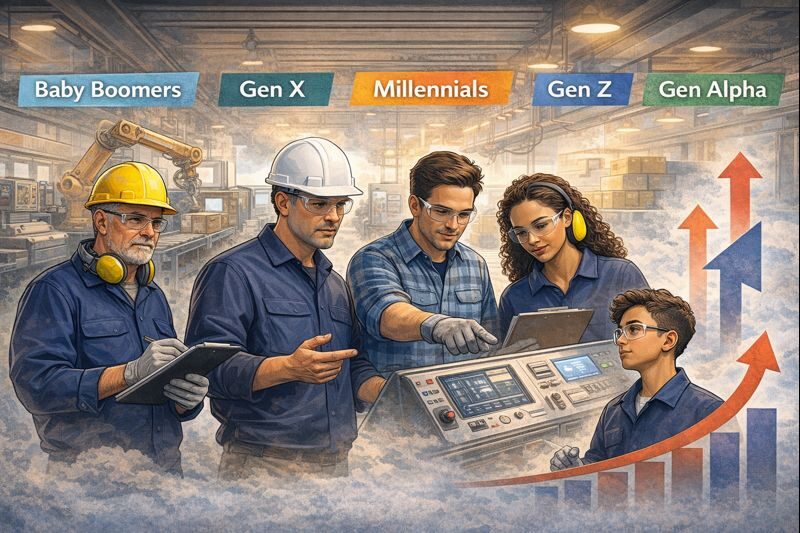
For the first time in history, five generations are working side by side on the factory floor:
- Baby Boomers delaying retirement
- Gen X leaders holding operations together
- Millennials stepping into management roles
- Gen Z redefining expectations around work
- Gen Alpha beginning to appear in training pipelines
What makes this moment different isn’t just age diversity. It’s the strain placed on front-line managers who are expected to bridge generational gaps without the tools, authority, or support to do so.
When retention breaks down, culture erodes, or turnover spikes, the root cause is rarely “the workforce.” It’s almost always leadership capacity at the supervisor and plant manager level.
In 2026, manufacturers that ignore this reality will pay for it in lost productivity, stalled growth, and constant rehiring. Those that address it head-on will build durable, resilient teams.
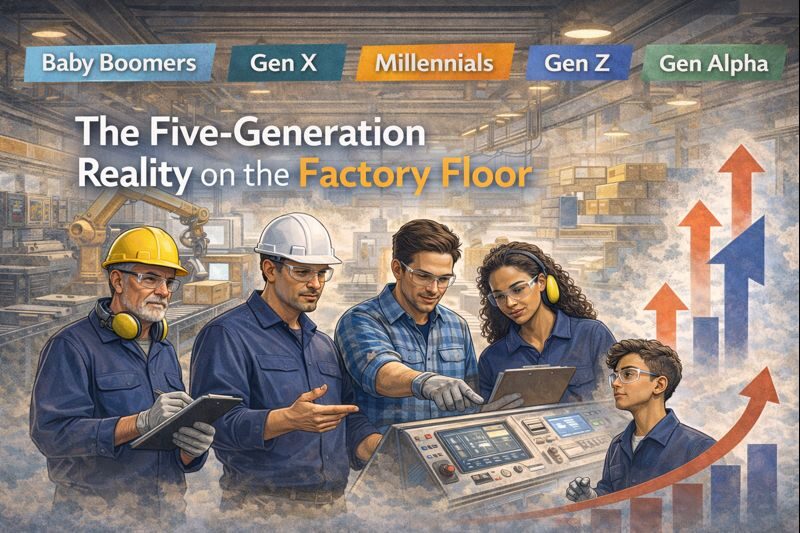
The Five-Generation Reality on the Factory Floor
Manufacturing leaders often acknowledge generational differences but few grasp the operational implications.
Each generation brings distinct assumptions about work, authority, and communication:
- Baby Boomers value loyalty, stability, and chain-of-command leadership
- Gen X prioritizes autonomy, pragmatism, and problem-solving
- Millennials seek purpose, feedback, and development pathways
- Gen Z expects transparency, flexibility, and psychological safety
- Gen Alpha (emerging) is digital-native, values inclusion, and questions rigid hierarchy
None of these perspectives are wrong but they frequently collide.
A single shift supervisor may manage:
- A 62-year-old technician who resents change
- A 45-year-old lead who resists micromanagement
- A 29-year-old engineer who wants faster advancement
- A 22-year-old operator who expects coaching, not commands
Without strong emotional intelligence in manufacturing leadership, conflict becomes inevitable.
Why Front-Line Managers Are Burning Out First
Plant managers and shift supervisors sit at the intersection of:
- Executive expectations
- Union or workforce pressure
- Safety compliance
- Production targets
- Human conflict
Yet most were promoted for technical competence, not people leadership.
This creates a dangerous mismatch:
- High responsibility
- Low authority
- Minimal leadership training
- Constant emotional labor
When managers burn out, the workforce follows.
Data consistently shows that employees don’t leave companies, they leave managers. In manufacturing, this effect is magnified because teams are interdependent and turnover creates immediate operational risk.
Bad Management Is the Fastest Driver of Turnover
Manufacturers often focus on:
- Wages
- Scheduling
- Benefits
- Automation
But exit interviews repeatedly reveal the same truth:
Poor front-line management drives voluntary attrition more than compensation alone.
Common failure points include:
- Inconsistent discipline across generations
- Poor conflict resolution on the factory floor
- Communication breakdowns between shifts
- Lack of feedback or recognition
- Perceived favoritism or rigidity
When these issues go unresolved, employees disengage quietly until they leave.
Soft Skills Are Now Hard Requirements for Manufacturing Leaders
In 2026, soft skills for manufacturing leaders are no longer optional add-ons. They are operational necessities.
Critical capabilities include:
- Active listening
- Conflict de-escalation
- Cross-generational communication
- Situational leadership
- Emotional regulation under pressure
Leaders who lack these skills create friction even when they are technically excellent.
Manufacturers that treat leadership as a technical promotion rather than a behavioral role will continue cycling through supervisors at an unsustainable pace.
Generational Conflict Isn’t Cultural It’s Structural
It’s tempting to frame generational friction as a cultural problem.
In reality, it’s a structural leadership issue.
Problems arise when:
- Expectations aren’t explicitly set
- Feedback loops are unclear
- Accountability differs by tenure
- Advancement paths are opaque
Generational conflict thrives in ambiguity.
Clear leadership frameworks reduce friction by aligning expectations across age groups without forcing uniformity.
Why Talent Traction Sees This Before the Market Does
As a white-glove recruitment and advisory partner, Talent Traction sits inside hiring conversations long before problems become visible externally.
Patterns we consistently see:
- Senior leaders underestimate supervisor churn
- Exit risk concentrates around specific managers
- Leadership gaps stall expansion plans
- Plants with strong managers outperform peers despite similar labor markets
This is not about motivational posters or training seminars.
It’s about placing the right leaders into roles where they can succeed and supporting them strategically.
Retention in 2026 Will Be Decided at the Manager Level
The future of manufacturing retention won’t be decided by:
- Another bonus program
- A new HR platform
- A revised handbook
It will be decided by:
- Who leads the shift
- How conflict is handled in real time
- Whether managers feel supported or isolated
Organizations that invest in leadership alignment, selection, and support will stabilize their workforce even in tight labor markets.
Those that don’t will continue hiring reactively.
What Plant Leaders Should Be Asking Now
As 2026 approaches, leadership teams should be asking:
- Do our front-line managers have the authority to lead?
- Are we promoting technical skill or leadership capability?
- Where is burnout highest and why?
- Which managers retain talent, and which repel it?
- Do we intervene early or wait until turnover spikes?
These are not HR questions.
They are business continuity questions.
Final Thought: The Workforce Has Changed Leadership Must Catch Up
Manufacturing didn’t become more complex overnight. But the human side of operations has.
Five generations on the same floor is not a trend, it’s the new normal.
Companies that recognize this and act deliberately will gain a competitive advantage that compounds over time.
Those that don’t will keep asking why hiring is so hard without realizing retention was the real issue all along.