The tire industry is one of the most competitive, mature markets in manufacturing. Global giants dominate shelf space, distribution networks are entrenched, and brand loyalty runs deep.
So how does a new entrant break through?
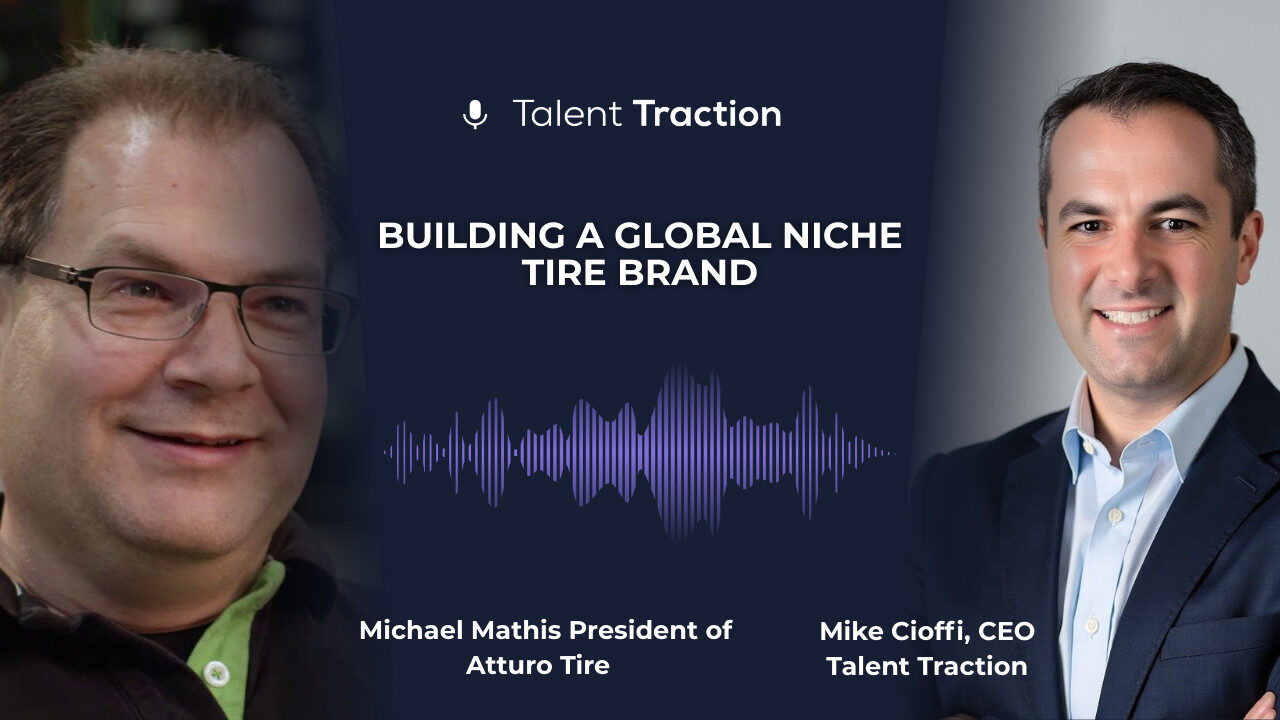
In this episode of the Talent Traction Podcast, Mike Cioffi sits down with Michael Mathis, President of Atturo Tire Corp, to unpack exactly how a niche tire brand can not only survive—but scale globally.
What emerges is a clear lesson:
👉 You don’t win by competing everywhere.
👉 You win by owning the gaps others ignore.
Starting with a Gap, Not a Product
Atturo didn’t start with scale. It started with focus.
Back in 2009, during one of the toughest economic environments, Atturo entered the market with a simple strategy:
- Identify clear gaps between premium brands and entry-level products
- Build targeted SKUs for underserved segments
- Partner with high-quality manufacturing sources
As Michael explains, the opportunity wasn’t to compete with the biggest players—it was to position in the “middle space” where demand existed but supply was weak.
That initial focus—just a handful of sizes and one tread pattern—was enough to gain traction quickly.
Lesson:
Most brands fail because they go too broad too early. Niche brands win by being painfully specific.
The Power of Staying Focused (Before Expanding)
Even today, Atturo’s core strength remains in:
- Light truck
- SUV
- Crossover segments
Why? Because globally, this is the fastest-growing category of vehicles on the road.
Only after building depth did Atturo expand into:
- Ultra high performance
- Passenger car fitments
- Powersports
This expansion wasn’t random—it followed a clear logic:
👉 “What else does our customer already own?”
That thinking is what separates strategic growth from reactive expansion.
Why Most Tire Brands Fail in the U.S.
Breaking into the U.S. market is where many tire brands collapse.
According to Michael, three things separate real brands from “commodity importers”:
1. Domestic Infrastructure
- Customer support
- Warranty service
- Local operations
Without this, you’re not a brand—you’re a shipment.
2. Inventory Depth
If you can’t support distributors between shipments, you can’t scale.
3. Brand Investment
There is no shortcut here.
“Free social media alone won’t get you there.”
Winning brands invest in:
- Paid media
- Website experience
- Consistent positioning
Insight:
Brand isn’t built on price—it’s built on presence.
The Breakthrough Moment: Timing + Product Insight
Every successful brand has an inflection point.
For Atturo, it was the launch of the Trail Blade XT, a rugged terrain tire.
- Entered a fast-growing segment early
- Missed being first by months—but still captured momentum
- Combined performance + aggressive aesthetics
What stood out wasn’t just function—but design appeal.
In the light truck segment, customers don’t just buy tires—they buy identity.
Key takeaway:
In niche categories, emotion often sells as much as performance.
Marketing Strategy: Sell to Consumers, Win Dealers
Atturo made a critical early decision:
👉 Focus marketing on the end consumer, not just the dealer.
Why?
Because:
- Dealers are also consumers
- Consumer pull makes dealer selling easier
This created a dual effect:
- Brand demand at retail
- Easier conversion at point of sale
From print and TV to digital campaigns, the goal was simple:
👉 Make the brand recognizable before the customer walks into the store.
Industry Reality: Consolidation + Opportunity
As pressure builds:
- Tier 1 brands face margin compression
- Layoffs and consolidation increase
- Consumers prioritize value
This creates a window for:
- Agile brands
- Focused operators
- Strong niche positioning
The companies that win aren’t the biggest—they’re the most disciplined.
Final Takeaway: The Niche Flywheel
What Atturo demonstrates is something bigger than just product strategy.
It’s a flywheel:
- Identify a gap
- Build a focused product
- Invest in brand
- Create consumer pull
- Support with distribution
- Expand adjacent segments
Repeat.
Closing Thought
You don’t need to be the biggest brand to win.
You need to be:
- The most relevant
- The most consistent
- The most disciplined in your positioning
Because in a crowded market,