Introduction: Tariffs Didn’t Just Reshape Supply Chains They Reshaped Labor
Manufacturing reshoring labor trends in 2026 are no longer a secondary consideration; they are now a board-level constraint.
For the better part of two decades, global manufacturers optimized for cost arbitrage: lower labor overseas, predictable logistics, and just-in-time inventory. That model is now structurally broken.
In 2026, tariffs are no longer tactical levers. They are permanent features of industrial policy. And as reshoring and near-shoring accelerate, manufacturers are discovering a hard truth:
You can move a factory faster than you can build a workforce.
This article examines how tariffs are reshaping industrial hiring, why labor costs are emerging as the hidden risk in reshoring, and what C-suite leaders must do now to avoid stalled plants, delayed launches, and margin erosion.

1. 2026: Why This Is the “Year of the Tariff”
Tariffs in 2026 are not about protectionism headlines, they are about operational reality.
What Changed:
- Persistent U.S.–China tariffs remain embedded across electronics, automotive, chemicals, and industrial components.
- Carbon-linked trade policies are raising costs on imported materials.
- National security and supply chain resilience have moved from rhetoric to regulation.
According to industry data:
- Over 65% of U.S. manufacturers are actively reshoring or expanding domestic capacity.
- Factory construction announcements are up, but time-to-production is slipping due to labor shortages.
Tariffs are pushing production home. Labor constraints are slowing it down.
2. Reshoring Is Easy on PowerPoint Hard in Practice
From a strategic planning perspective, reshoring looks straightforward:
- Secure incentives
- Select a site
- Build a facility
- Hire talent
In reality, staffing new factories in the USA has become the most fragile link in the chain.
The Reality on the Ground:
- Skilled trades pipelines are thin
- Leadership talent is regionally concentrated
- Wage expectations vary dramatically by market
- Local labor competition is intense
In many regions, multiple manufacturers are competing for the same finite workforce often within a 50-mile radius.
3. Labor Cost Inflation: The Unmodeled Tariff
Most reshoring financial models account for:
- Construction costs
- Equipment
- Utilities
- Logistics
What they underestimate is labor cost escalation.
What We’re Seeing in 2026:
- Skilled technician wages up 15–25% in high-reshoring regions
- Plant managers and operations leaders commanding premiums due to scarcity
- Retention bonuses and shift differentials becoming standard not optional
Tariffs may increase input costs by single digits. Labor miscalculations can erode margins by double digits.
4. Site Selection Is Now a Talent Decision, Not a Tax Decision
Historically, site selection prioritized:
- Tax abatements
- Real estate
- Logistics access
In 2026, labor availability has become the gating factor.
Key Shifts in Site Selection Committees:
- Workforce data now outweighs incentive packages
- Rural vs. metro trade-offs are being re-evaluated
- Proximity to competitor plants is scrutinized
A $10M incentive means little if a plant can’t staff its second shift.
5. The Leadership Gap No One Modeled
One of the most overlooked reshoring risks is leadership density.
Opening a factory requires more than operators:
- Plant managers
- Maintenance leaders
- Quality heads
- Safety and compliance leadership
- HR and labor relations experts
These roles are not entry-level and not easily relocated.
Manufacturers that underestimate leadership hiring timelines often experience:
- Delayed commissioning
- Safety incidents
- Culture breakdowns
- Early attrition
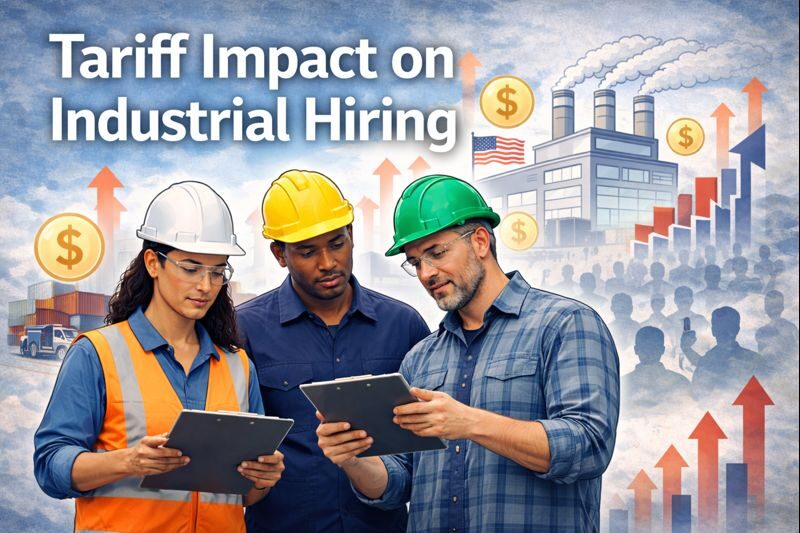
6. Tariff Impact on Industrial Hiring: The Domino Effect
Tariffs don’t just change where things are made they change who gets hired, where, and at what cost.
Downstream Effects:
- Tier-2 and Tier-3 suppliers reshore simultaneously
- Local labor markets tighten rapidly
- Training capacity becomes constrained
- Competition for the same skill sets intensifies
In many regions, reshoring has created talent bottlenecks, not job surpluses.
7. Why “We’ll Train Locally” Isn’t a Standalone Strategy
Training is essential but insufficient on its own.
The Training Reality:
- Apprenticeships take years, not months
- Community colleges are under-resourced
- Experienced mentors are scarce
- Productivity ramps slowly
Training must be paired with experienced external hires to stabilize operations during ramp-up.
8. Supply Chain Talent Resilience: The New Competitive Advantage
In 2026, the strongest manufacturers are not those with the lowest labor costs but those with the most resilient talent strategies.
Resilient organizations:
- Hire leadership early, not reactively
- Blend local talent with relocated expertise
- Invest in employer reputation before hiring surges
- Treat workforce planning as a strategic function, not an HR task
Talent resilience now directly correlates with:
- Faster time-to-production
- Fewer safety incidents
- Higher first-year retention
- Better margin stability
9. The Role of White-Glove Recruitment in Reshoring
As labor markets tighten, transactional hiring models fail.
Reshoring environments demand:
- Confidential leadership searches
- Industry-specific talent mapping
- Relocation strategy
- Culture and operational alignment
This is why more manufacturers are shifting toward white-glove search partners not to hire faster, but to hire right.
10. What C-Suite Leaders Should Be Asking Right Now
Before approving any reshoring or expansion plan, executives should ask:
- Do we understand the true labor cost curve for this region?
- Who will lead this facility, not just open it?
- How competitive is our employer brand locally?
- What happens if our hiring timeline slips by 6 months?
- Do we have a talent partner who understands industrial complexity?
These questions are no longer optional. They are risk controls.
Conclusion: Tariffs Triggered Reshoring Talent Will Decide Outcomes
2026 will be remembered not just as the year tariffs reshaped manufacturing but as the year labor strategy separated winners from stalled projects.
Factories can be built quickly. Workforces cannot.
Manufacturers that treat reshoring as a talent strategy first not a logistics exercise will scale faster, operate safer, and protect margins in an increasingly constrained labor market.
Those that don’t will discover that tariffs were only the beginning.