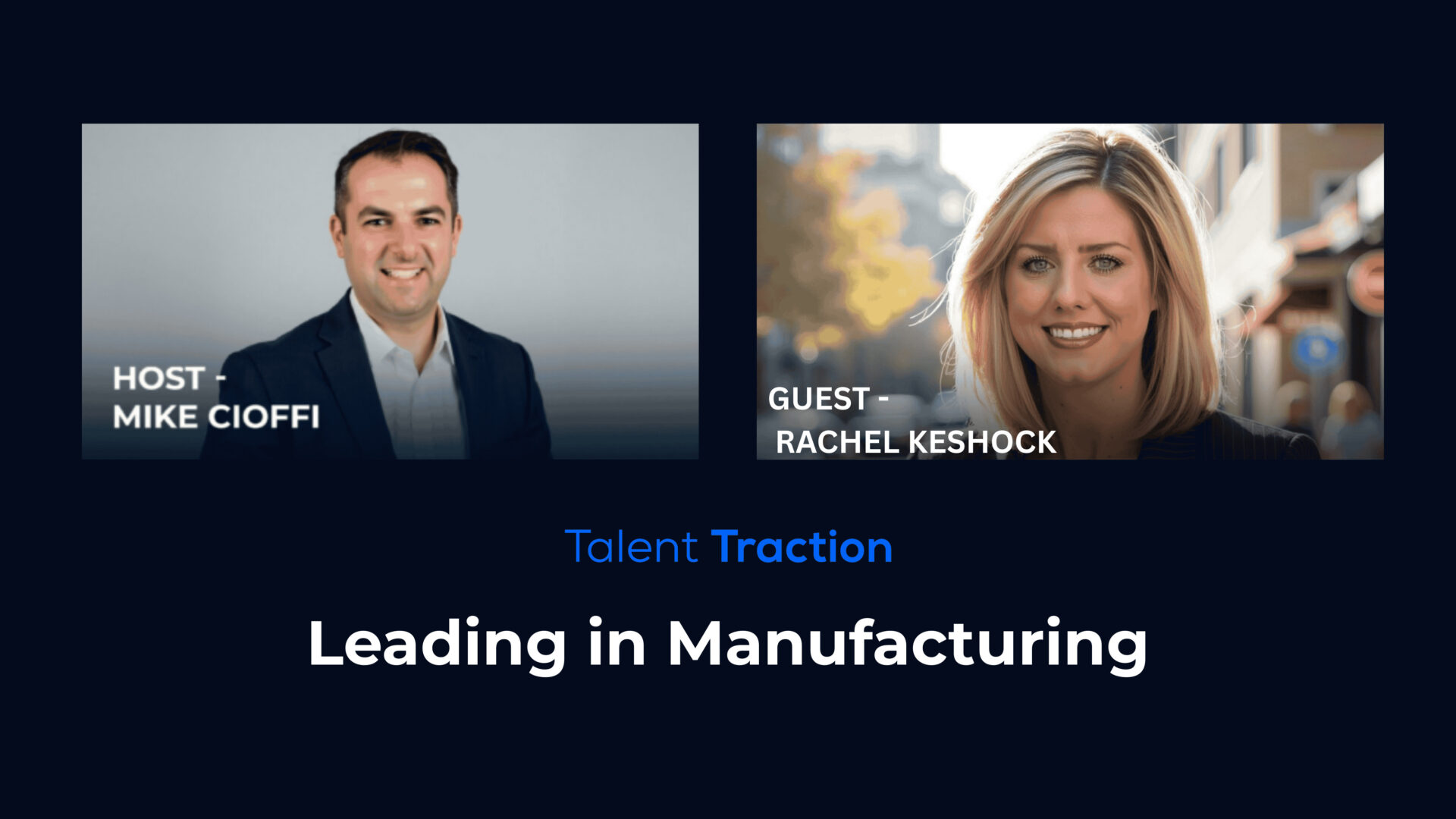
Podcast Conversation with Rachel Keshock, Director of Sales at Baerlocher
Modern manufacturing leadership is no longer defined by scale, legacy, or price alone. It’s defined by how organizations think, collaborate, and create value across the entire value chain. In this episode of the Talent Traction Podcast, Rachel Keshock, Director of Sales at Baerlocher, shares a grounded and experience-driven perspective on what it truly means to lead in today’s industrial and plastics manufacturing environment.
Rachel frames the conversation around three critical pillars that are reshaping industrial sales and leadership today:
- Transforming commercial excellence
- Empowering teams to think and lead independently
- Shaping a more sustainable future for customers, partners, and talent
What emerges is not a playbook of buzzwords but a leadership mindset built for complexity, accountability, and long-term impact.
Transforming Commercial Excellence: A Mindset, Not a Program
For Rachel, commercial excellence is not about change for the sake of change. It’s about modernizing how organizations operate intentionally and thoughtfully.
“It’s not about perfection. It’s about excellence as a mindset.”
Transforming commercial excellence means elevating commercial rigor, strengthening cross-functional alignment, and committing to continuous improvement. In large manufacturing organizations where SOPs, governance, and scale can slow momentum this transformation starts with leadership behavior.
When leaders embody excellence, set clear expectations, and hold themselves and others accountable, excellence becomes consistent rather than fragmented.
Rising Customer Expectations in Manufacturing
Rachel highlights a critical shift: customer expectations today are far higher than they were a decade ago.
Manufacturing buyers are:
- Wearing multiple hats
- Measured against aggressive KPIs
- Under pressure to grow revenue while reducing costs
As a result, industrial sales teams must elevate beyond transactional selling.
Modern customers expect partners who can:
- Help grow top-line revenue
- Reduce operational and production costs
- Improve efficiency and throughput
- Build trust through consistency and reliability
Price alone no longer defines value.
Customer Experience Is the New Differentiator
One of the most resonant insights from the conversation is that commercial excellence shows up in the customer experience.
Customers don’t always choose the cheapest supplier. They choose partners who:
- Save them time
- Reduce friction
- Deliver consistently
- Close loops instead of creating follow-ups
“It’s about being a true partner not just a vendor.”
Rachel emphasizes understanding why customers buy. What motivates them? What pressures are they under internally? What does success look like for their leadership team?
That understanding allows manufacturers to align solutions not just products to real business outcomes.
A Practical Example from the Field
Rachel shares a powerful example:
When a customer’s manufacturing facility struggled with processing inefficiencies, Baerlocher didn’t simply offer a product. Instead, technical teams, engineers, and operations experts worked directly inside the facility to streamline processes.
The result:
- Improved operational efficiency
- Reduced costs
- Stronger long-term partnership
This is commercial excellence in action problem-solving at the point of impact.
Empowering Teams: Building the Next Generation of Manufacturing Leaders
The second pillar Rachel emphasizes is empowerment, and she is clear: empowerment is intentional, not accidental.
Empowered teams are built by:
- Putting the right people in the right roles
- Providing clear responsibilities and accountability
- Equipping teams with the right tools and training
- Allowing decision-making autonomy
“Most mistakes in sales are fixable. We’re not surgeons.”
This mindset creates strategic thinkers, not order-takers.
Leadership Culture Determines Empowerment
Rachel points out a hard truth: empowerment only works when leadership wants it.
Organizations that value empowerment:
- Trust their people
- Encourage learning through experience
- Accept fixable mistakes as growth opportunities
In more hierarchical environments, empowerment can still be enabled through systems and tools.
Practical Tools That Enable Autonomy
Examples Rachel shares include:
- Pricing bands that define approval thresholds
- Negotiation frameworks with clear guardrails
- Decision-support tools and Q&A playbooks
These structures don’t remove accountability they enable independent thinking while maintaining control.
The result? Teams that move faster, think critically, and develop leadership capability early.
Navigating Economic Pressure, Tariffs, and Market Uncertainty
The manufacturing sector has faced sustained pressure over the last several years from tariffs and supply chain volatility to rising interest rates and uncertain demand recovery.
Rachel notes that tariffs have:
- Increased competition
- Driven supplier switching
- Forced cost compression across the value chain
Despite this, strong team dynamics and cross-functional collaboration have helped mitigate impact internally.
“Doing More With Less” Is the New Normal
Across manufacturing, Rachel observes:
- Roles not being backfilled
- Teams absorbing additional responsibilities
- Companies “top grading” talent rather than expanding headcount
This reflects broader softness in hiring and caution in growth but also reinforces why commercial excellence and empowered teams matter more than ever.
Preserving margins today requires smarter execution, not just scale.
Competing as a Premium Brand in a Price-Driven Market
One of the toughest challenges manufacturers face is competing against lower-cost providers especially during economic slowdowns.
Rachel’s perspective is pragmatic:
- You must understand why customers buy
- You must align solutions to their annual goals
- You must sell differently across specialty vs. commodity segments
Premium brands succeed when they:
- Sell on value, not features
- Adapt go-to-market strategies by segment
- Remain agile as market conditions shift
“You have to transform as the environment around you shifts.”
Attracting the Next Generation to Manufacturing
Rachel is particularly passionate about engaging younger generations in manufacturing and plastics.
With AI and technology drawing talent toward software and digital-first industries, manufacturing must:
- Spend time on college campuses and in schools
- Partner with educational institutions
- Tell a better story about innovation, technology, and impact
Younger professionals want to:
- Work with advanced technology
- Shape industries, not just operate within them
- See long-term opportunity and purpose
Manufacturing has that opportunity but it must be communicated clearly and authentically.
Shaping a More Sustainable Future
The final pillar Rachel outlines is sustainability but not as a standalone initiative.
“Growth balances performance today with responsibility for tomorrow.”
Sustainability, in this context, includes:
- Thoughtful innovation
- Long-term partnerships
- Decisions rooted in integrity
- Safety and responsibility across the value chain
For Gen Z and emerging leaders, sustainability and ethics are non-negotiable. Companies that invest in these areas are better positioned to attract, retain, and inspire top talent.
Sustainability isn’t just good citizenship it’s a competitive advantage.
Final Thoughts: Leadership That Lasts
Rachel Keshock’s perspective reinforces a powerful truth for manufacturing leaders:
Commercial excellence, empowered teams, and sustainability are not separate initiatives they are interconnected leadership disciplines.
Organizations that:
- Lead with clarity and accountability
- Trust and develop their people
- Partner deeply with customers
- Act with integrity and long-term vision
…are the ones best positioned to thrive regardless of economic cycles or market uncertainty.