If you are trying to hire industrial talent in the Northeast and your offers keep getting rejected, there is a strong chance your compensation is out of step with the market and you may not even know it. Having current industrial roles salary benchmarks for the Northeast USA is no longer a nice-to-have for HR directors and plant managers. It is a prerequisite for building a competitive talent strategy in 2026.
Here is why this matters more than ever right now: total employer compensation in U.S. manufacturing averaged $46.30 per hour in Q2 2025, according to BLS Employer Costs for Employee Compensation data with benefits accounting for roughly one-third of that total. The U.S. manufacturing sector is carrying approximately 4.2% of roles unfilled as of Q3 2025, per the National Association of Manufacturers’ outlook surveys. In the Northeast, where the cost of living consistently outpaces the national average, that vacancy pressure is even more acute. Companies working from outdated salary data are not just losing offers they are losing searches before they even start, because candidates never make it past the first screening conversation.
This guide gives you current, state-level salary data for 10 of the most in-demand industrial roles in the Northeast: New York, New Jersey, Connecticut, Pennsylvania, and Massachusetts. Use it to pressure-test your job descriptions, validate your internal pay grades, and make faster, better offer decisions.
Why the Northeast Is a Distinct Market for Industrial Compensation
The Northeast United States is one of the most compensation-dense industrial markets in the country and one of the most expensive to hire in. Understanding why helps contextualize the numbers throughout this guide.
Cost of living is the baseline driver. New York, New Jersey, Connecticut, and Massachusetts consistently rank among the top 10 most expensive states in the country for cost of living. An industrial candidate evaluating your offer is not comparing it to a national average; they are comparing it to what their peers are earning in the same region, while paying Northeast rents and property taxes. A salary that looks competitive at the national level can land well below market expectations for a candidate in Stamford, Boston, or Philadelphia.
Talent density creates competition, not supply. The Northeast hosts a high concentration of industrial operations pharmaceutical and chemical manufacturing in New Jersey, aerospace and defense in Connecticut, advanced manufacturing in Massachusetts, logistics and industrial distribution in Pennsylvania. This creates a relatively thick market of experienced candidates, but also means those candidates have many options. The best talent is not comparing your offer to one other employer. They may have two or three active conversations simultaneously.
Benefits matter as much as base pay. BLS data confirms that roughly one-third of total compensation in manufacturing consists of non-wage benefits, health insurance, retirement contributions, and paid leave. In the Northeast, where employer-sponsored health insurance commands a significant premium, candidates are increasingly evaluating total compensation rather than base salary alone. Employers who lead with base and lag on benefits are structurally disadvantaged in offer negotiations.
With that context established, here is the role-by-role breakdown.
The 2026 Salary Benchmarks: 10 Key Industrial Roles Across the Northeast
1. Plant Manager
The plant manager is arguably the most competitively contested role in industrial recruiting. Demand is high, the pool of genuinely qualified candidates is small, and salary expectations in the Northeast reflect both.
As of January 2026, average plant manager salaries in the Northeast’s key industrial states are: Massachusetts ($208,951), New Jersey ($208,107), Connecticut ($205,188), New York ($204,113), and Pennsylvania ($191,134).
These figures reflect experienced, multi-function leaders managing full plant operations. Compensation scales significantly based on plant size, unionized vs. non-union environment, industry sub-sector, and P&L ownership. A plant manager at a 50-person specialty manufacturer will not command the same package as one leading a 400-person automotive components facility.
Hiring reality check: At these salary levels, you are competing nationally not just regionally. Many candidates at this tier have flexibility to commute long distances or relocate if the opportunity and package are right. Don’t anchor your search geography too tightly.
2. Supply Chain Manager
As of February 2026, average supply chain manager salaries across key Northeast states are: Massachusetts ($141,716), New Jersey ($141,143), Connecticut ($139,164), New York ($138,435), and Pennsylvania ($129,632).
Supply chain management has become one of the most strategically valued functions in industrial operations since the disruptions of 2020–2022 permanently elevated its profile. Candidates with demonstrated experience in vendor risk management, nearshoring strategy, and ERP implementation command a meaningful premium above these averages.
At the senior manager level, Northeast supply chain salaries step up significantly: Massachusetts ($185,846), New Jersey ($185,094), Connecticut ($182,499), and New York ($181,542).
Hiring reality check: Supply chain talent is being recruited hard by sectors outside of industrial retail, healthcare, and tech all need supply chain leaders. If you are not presenting a competitive total package and a compelling career story, you will lose candidates to non-industrial employers even when your base is in range.
3. Industrial Engineering Manager
Industrial engineering managers are the operational backbone of manufacturing efficiency overseeing lean implementation, capacity planning, and process improvement. They are consistently among the hardest roles to fill in the Northeast.
As of November 2025, average industrial engineering manager salaries by Northeast state are: Massachusetts ($143,592), New Jersey ($143,012), New York ($140,268), Connecticut ($141,006), and Pennsylvania ($131,348).
At the individual contributor level, industrial engineers (not managers) in the Northeast earn in a different band. In New York, the average industrial engineering salary as of December 2025 is $91,349 per year, with top earners at the 90th percentile reaching approximately $120,890. In New Jersey, the average comes in at $84,770 annually, with the majority of roles ranging between $71,100 and $95,900.
Hiring reality check: Lean Six Sigma certification, AutoCAD proficiency, and experience with simulation software (Arena, Simio) all command salary premiums. If your job description requires these skills, your compensation must reflect them.
4. Quality Engineer / Quality Manager
Quality roles have grown in both scope and compensation as regulatory requirements, customer quality expectations, and ISO/IATF certification standards have raised the bar on what these professionals must manage.
As of November 2025, manufacturing quality engineer average salaries across the Northeast are: Massachusetts ($109,296), New Jersey ($108,854), Connecticut ($107,327), New York ($106,765), and Pennsylvania ($99,976).
Quality manager roles (as distinct from individual contributor quality engineers) sit meaningfully above these figures. In the Northeast, quality managers with IATF 16949 or AS9100 experience in automotive or aerospace environments typically command $115,000 to $145,000 depending on scope and plant size.
Hiring reality check: Quality professionals are mobile. A quality engineer with five years of experience and a CQE certification in Bridgeport, CT is acutely aware that Boston, New York, and Philadelphia employers are all within striking distance and all paying competitively. Location-based discounting in quality compensation is rarely successful.
5. Production / Manufacturing Engineer I–III
Entry to mid-level production and manufacturing engineers form the operational layer between quality, plant management, and front-line production. They are one of the most consistently in-demand roles in industrial hiring.
As of November 2025, Production Engineer I average salaries in the Northeast are: Massachusetts ($86,036), New Jersey ($85,688), Connecticut ($84,486), New York ($84,043), and Pennsylvania ($78,699).
At the Engineer III / Senior level, these figures scale upward by roughly 30–40% depending on industry. Senior manufacturing engineers in pharmaceutical and aerospace sub-sectors in the Northeast regularly earn $115,000 to $135,000.
Hiring reality check: Recent engineering graduates often have multiple competing offers in the industrial sector. Onboarding experience, mentorship structure, and career development trajectory are increasingly influential offer decision factors for this group, not just starting salary.
6. CNC Machinist
CNC machinists represent one of the clearest examples of a skilled trades compensation gap. The national average masks significant regional variation, and the Northeast pays meaningfully above the national midpoint for experienced CNC operators and programmers.
The national average CNC machinist salary as of February 2026 is $27.56 per hour based on Indeed data from more than 31,000 job postings approximately $57,300 annually. In the Northeast, experienced CNC machinists with 5+ years of experience on multi-axis equipment earn meaningfully more. Massachusetts and Connecticut machinists, particularly those working in aerospace and defense supply chains regularly see offers in the $65,000 to $80,000 range. New York machinists with 3-5 axis capability typically earn $58,000 to $72,000.
CNC programmers (a step above operator) command a further premium. Northeast CNC programmers with CAM software proficiency and experience in tight-tolerance work typically earn $70,000 to $90,000.
Hiring reality check: The CNC talent pool in the Northeast is genuinely constrained. Community college programs that train machinists have not kept pace with demand. Many of the best CNC machinists are employed and not actively searching making this a role where passive candidate outreach is essential and urgency should not be mistaken for desperation in the offer.
7. Maintenance Technician / Maintenance Manager
Maintenance technicians are the unsung linchpin of industrial operations. When they’re hard to find and they increasingly are, production suffers. In the Northeast, electrically and mechanically dual-qualified maintenance techs are among the most sought-after tradespeople in any industrial sector.
General maintenance technician salaries in the Northeast range from $55,000 to $75,000 for experienced personnel, with multi-trade (electrical + mechanical + PLC) technicians often commanding $70,000 to $85,000 in states like New Jersey, Connecticut, and Massachusetts. Maintenance managers in the Northeast typically earn $90,000 to $120,000 depending on facility size and complexity.
BLS data on industrial machinery installation, maintenance, and repair workers shows consistent wage growth in the Northeast region over the last three years, driven by the acceleration of automated and semi-automated production lines that require higher technical competence to maintain.
Hiring reality check: PLC programming experience (Allen-Bradley, Siemens), hydraulics knowledge, and predictive maintenance experience are skills that can push maintenance tech compensation 15–25% above the midpoint. If your requirements include these skills but your pay range doesn’t, expect a very thin applicant pool.
8. Welder (MIG / TIG / Pipe)
Welding compensation in the Northeast varies significantly by specialty, a gap that many employers underestimate when setting pay ranges.
As of March 2026, Welder I average salaries in the Northeast are: Massachusetts ($49,337), New Jersey ($49,138), Connecticut ($48,450), New York ($48,195), and Pennsylvania ($45,130).
These are entry-level figures. Experienced Journeyman Welders in the Northeast earn $55,000 to $65,000. Pipe welders particularly those certified in structural or pressure pipe earn significantly more: pipe welder averages in the Northeast as of March 2026 are Massachusetts ($63,074), New Jersey ($62,819), Connecticut ($61,938), New York ($61,613), and Pennsylvania ($57,696).
For specialized welders, aerospace TIG welders, certified pipe welders with ASME Section IX credentials, structural welders working to AWS D1.1 compensation routinely exceed $70,000 and can approach $85,000+ in defense and aerospace supply chain environments in Connecticut and Massachusetts.
Hiring reality check: Welding certifications (AWS CWI, 6G pipe, ASME) add meaningful value and should be compensated accordingly. Employers who pay certified welders the same as uncertified candidates will not retain them.
9. Logistics / Transportation Manager
Logistics and transportation management sits at the intersection of industrial operations and supply chain and it is a function that has seen consistent compensation growth since 2020 as complexity and strategic importance have both risen.
Northeast logistics and transportation managers typically earn $85,000 to $120,000 depending on scope, with those managing multi-site or multi-modal operations at the higher end of that range. Regional distribution managers in New Jersey and Pennsylvania, two of the most logistics-intensive states in the country due to their proximity to major ports and population centers, often command $100,000 to $130,000 for experienced professionals.
Hiring reality check: Logistics and transportation managers increasingly need technology proficiency (TMS platforms, route optimization software, carrier management systems) alongside their operational backgrounds. Candidates with this combination are scarcer and better compensated than those with operational experience alone.
10. Health, Safety & Environmental (HSE) Manager
HSE roles have steadily risen in both strategic importance and compensation across industrial operations, driven by OSHA enforcement intensity, corporate ESG commitments, and the genuine operational and reputational cost of safety incidents.
HSE managers in Northeast industrial settings typically earn $85,000 to $115,000. In regulated industries such as chemical, pharmaceutical, and aerospace manufacturing where EHS complexity is highest, total compensation can reach $120,000 to $140,000 for experienced professionals.
HSE directors at multi-site operations in the Northeast typically earn $130,000 to $160,000+.
Hiring reality check: OSHA 30 certification is a baseline. Candidates with experience managing VPP (Voluntary Protection Program) participation, ISO 45001 implementation, or process safety management (PSM) credentials are meaningfully harder to find and should be compensated at the upper end of these ranges.
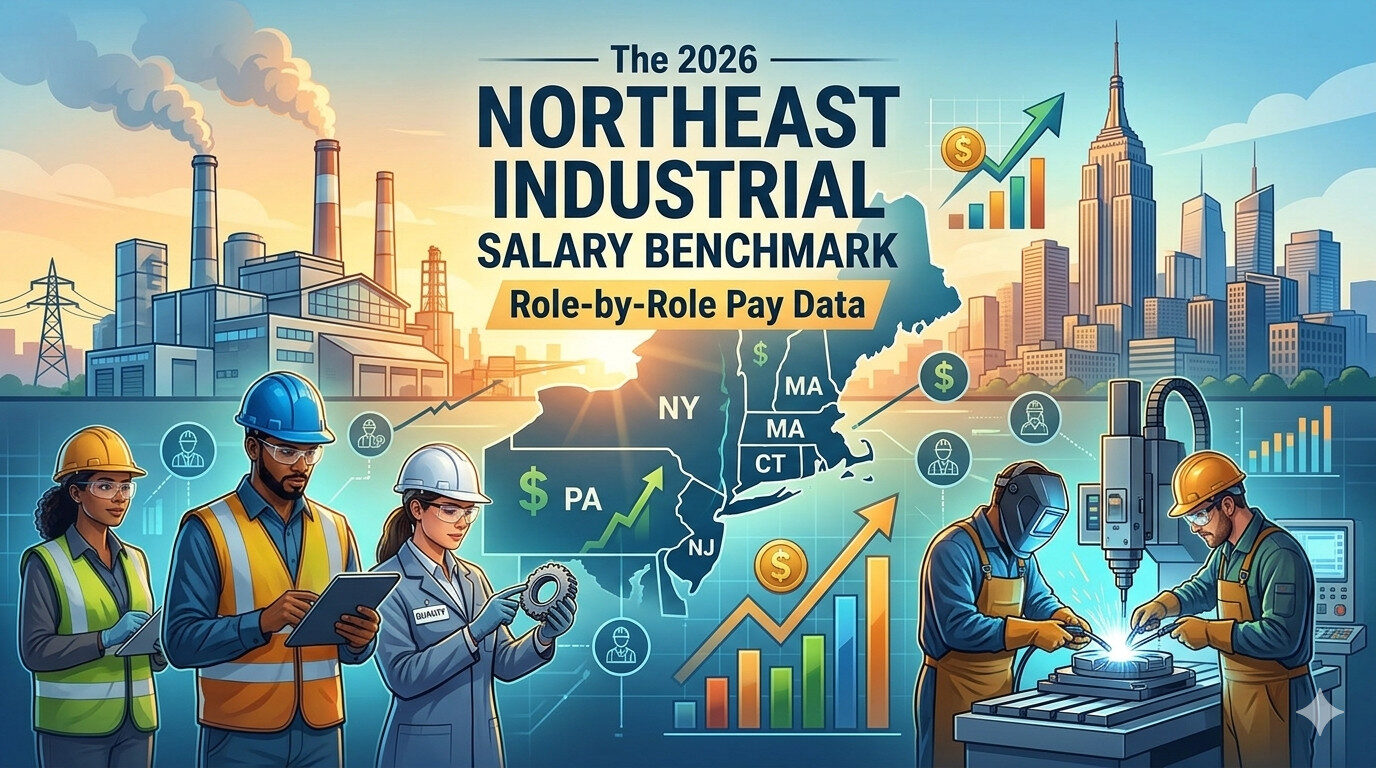
The 2026 Northeast Industrial Salary Benchmark Summary Table
Use this as a quick reference when opening searches or pressure-testing existing pay grades. Ranges reflect typical Northeast market compensation for experienced, mid-career professionals. Entry-level candidates will fall below the low end; senior or leadership-tier candidates will exceed the high end.
|
Role |
NY |
NJ |
CT |
MA |
PA |
|
Plant Manager |
$195K–$215K |
$195K–$215K |
$195K–$210K |
$195K–$215K |
$180K–$200K |
|
Supply Chain Manager |
$130K–$150K |
$132K–$150K |
$130K–$148K |
$132K–$152K |
$120K–$140K |
|
Industrial Engineering Manager |
$132K–$155K |
$134K–$157K |
$132K–$155K |
$134K–$158K |
$122K–$145K |
|
Quality Engineer |
$98K–$118K |
$100K–$120K |
$99K–$118K |
$100K–$120K |
$92K–$112K |
|
Manufacturing Engineer I |
$78K–$96K |
$79K–$97K |
$78K–$95K |
$79K–$98K |
$72K–$90K |
|
CNC Machinist (experienced) |
$58K–$72K |
$60K–$74K |
$62K–$78K |
$62K–$80K |
$55K–$70K |
|
Maintenance Technician (multi-trade) |
$65K–$82K |
$66K–$84K |
$66K–$84K |
$67K–$85K |
$60K–$78K |
|
Welder (Journeyman) |
$52K–$65K |
$52K–$66K |
$53K–$66K |
$53K–$67K |
$48K–$62K |
|
Logistics / Transportation Manager |
$90K–$120K |
$92K–$125K |
$88K–$118K |
$90K–$120K |
$88K–$118K |
|
HSE Manager |
$85K–$115K |
$87K–$117K |
$85K–$115K |
$88K–$118K |
$80K–$110K |
Ranges represent typical mid-career compensation including base salary. Total compensation (base + bonus + benefits) will be higher. Data compiled from Salary.com, ZipRecruiter, Indeed, and BLS OEWS as of Q1 2026.
What These Benchmarks Tell You About the 2026 Northeast Industrial Hiring Market
Looking across these 10 roles, three clear patterns emerge that should shape how you approach industrial hiring in the Northeast this year.
Pattern 1: The Northeast premium is real and growing. In virtually every role, Northeast salaries run 8–18% above the national average. Massachusetts, New Jersey, and Connecticut consistently top the Northeast rankings, with New York close behind. Pennsylvania generally runs slightly below the Northeast average but comfortably above the national midpoint. Employers using national benchmark data without regional adjustment are structurally underpricing their offers.
Pattern 2: Specialization commands disproportionate premiums. The gap between a general welder and a certified pipe welder is 25–35%. The gap between a junior manufacturing engineer and a senior engineer with ERP and lean credentials is 30–40%. In every role category, specific skills, certifications, and industry-sector experience push compensation significantly above the published averages. If your role has specific technical requirements, your compensation must reflect the scarcity premium for those qualifications not just the median for the job title.
Pattern 3: Benefits are now a competitive differentiator, not a baseline assumption. Total employer compensation in manufacturing averaged $46.30 per hour in Q2 2025, with benefits accounting for about one-third of that total. In the Northeast, where healthcare costs and retirement security are top-of-mind for candidates across all levels, employers who lead on health insurance quality, 401(k) matching, and paid leave will convert at meaningfully higher rates than those competing on base salary alone. Candidates are increasingly sophisticated about evaluating total compensation and a weak benefits package at a competitive base is a losing combination.
How to Use Salary Benchmarks to Improve Offer Acceptance Rates
Raw benchmark data is only useful if it is acted on. Here is how the best hiring organizations in the Northeast industrial market translate salary intelligence into offer results.
Compress the time between market analysis and job posting. Salary data shifts. A benchmark from 18 months ago in manufacturing which experienced significant wage pressure in 2022–2024 may understate current market rates by 10–15%. Make benchmark review a standard step in every search opening, not an annual HR exercise.
Build compensation flexibility into approvals before the search opens. One of the most common deal-killers in industrial hiring is reaching an excellent candidate only to discover your approved range is below market and then losing 2–3 weeks navigating internal approvals. If your benchmark analysis at search opening tells you the role requires $135,000 and your approved range is $125,000, resolve that gap before the first candidate conversation.
Communicate total compensation, not just base. A $120,000 base salary with an 8% bonus, full family health coverage, 5% 401(k) match, and 4 weeks of PTO represents a total compensation package that is meaningfully more competitive than the base suggests. Presenting total comp clearly in the offer stage rather than surprising candidates with benefit details reduces the chance that candidates anchor on base-only comparisons with competing offers.
Use benchmarks to have honest conversations with hiring managers. Salary data is most valuable when it creates alignment between HR, the hiring manager, and executive approval before a search begins. An HR director walking into a hiring conversation with current, state-level data is in a far better position to manage expectations and accelerate decisions than one working from outdated internal grades.
When Your Compensation Is Right But You’re Still Not Filling Roles
Salary benchmarks explain a significant portion of industrial hiring struggles but not all of them. If your compensation is genuinely market-competitive and you are still struggling to fill roles, the constraint is likely elsewhere.
It may be a candidate sourcing problem. If your recruiting strategy relies primarily on job board applicants, you are only reaching the portion of the talent market that is actively searching which, in the Northeast’s tight industrial market, represents a small fraction of the total qualified pool. The best candidates for most of these roles are currently employed and not sending out resumes.
It may be a process speed problem. Industrial candidates who are actively evaluating a move are typically in conversations with multiple employers simultaneously. Hiring processes that run six to eight weeks from first interview to offer consistently lose their top choices to faster-moving competitors.
It may be an employer brand problem. In a region where word travels quickly within industrial networks, your company’s reputation as an employer how you treat candidates during the process, how you manage onboarding, whether you follow through on commitments directly affects your ability to attract and convert top talent.
All three of these constraints are solvable. But they require different interventions than compensation adjustment and recognizing which problem you actually have is the first step to fixing it.
Final Thought: Salary Benchmarks Are a Starting Line, Not a Strategy
Current, accurate salary data is foundational to competitive industrial hiring in the Northeast but it is not sufficient on its own. The organizations winning the talent competition in 2026 are using compensation data as the starting line: a baseline that ensures they are in the game, not a strategy that gets them to the finish line.
What gets them to the finish line is a combination of accurate benchmarking, a compelling employer brand, a fast and respectful hiring process, and increasingly a recruitment partner who has deep relationships in the specific talent pools they need to reach.
If your industrial operation in the Northeast is struggling to fill key roles, whether that is a plant manager in New Jersey, a quality engineer in Massachusetts, or a CNC machinist in Connecticut, Talent Traction specializes in exactly these searches. Our team brings current market intelligence, a relationship-based candidate network in the industrial sector, and a structured process built around hire quality and long-term fit.