Why Workplace Safety Employer Brand Now Decides Who Works for You
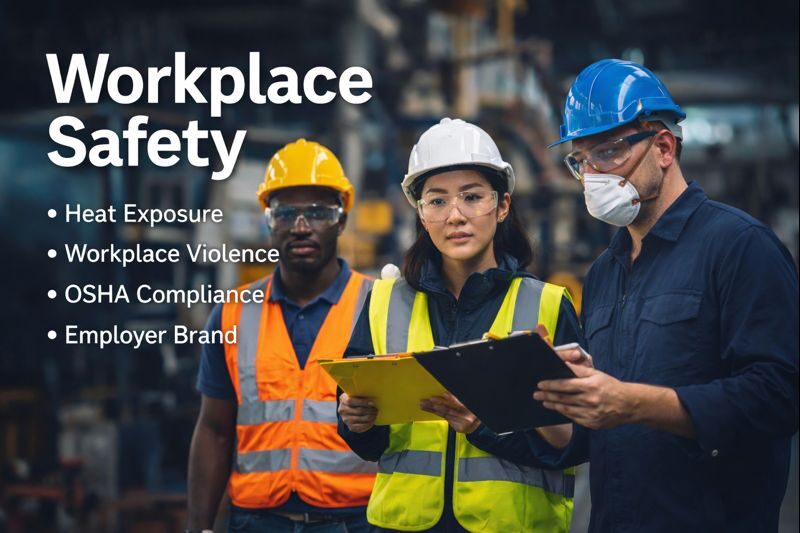
In 2026, workplace safety employer brand is no longer an internal operations issue, it is a frontline talent strategy. Heat exposure, workplace violence, and heightened OSHA enforcement are converging to create a new reality: the companies that win talent are the ones that protect it visibly, proactively, and credibly.
This shift is not theoretical. It is already showing up in hiring data, turnover patterns, and executive search conversations across manufacturing, industrial, automotive, logistics, and construction sectors in the U.S.
Candidates especially skilled frontline workers, supervisors, and plant leaders are asking new questions:
- How does this company handle extreme heat?
- What happens when a safety incident occurs?
- Is leadership reactive or prepared?
The answers to those questions now determine whether offers are accepted, leaders stay, and organizations avoid becoming known as “OSHA problems” instead of employers of choice.
This article explores why 2026 is a turning point for workplace safety, how heat and violence risks are reshaping employer reputation, and what it means to build an “OSHA-proof” brand that attracts not repels top talent.
The New Reality: Safety Is No Longer a Compliance Function
For decades, safety lived in binders, audits, and training sessions. It mattered but mostly after something went wrong.
That era is over.
In 2026:
- Safety is visible.
- Safety is discussed publicly.
- Safety is evaluated by candidates before Day One.
OSHA citations, heat-related incidents, and violent events now surface instantly through:
- Online reviews
- Social media
- Union channels
- Local news
- Word-of-mouth within tight labor markets
What used to be an internal HR or EHS issue has become an external reputation signal.
The Shift in Candidate Psychology
According to multiple workforce studies between 2023–2025:
- Over 70% of frontline workers say safety conditions influence whether they stay with an employer.
- Nearly 60% of candidates research workplace conditions before accepting an offer.
- Skilled trades workers increasingly compare employers based on how safe they feel, not just pay.
In practical terms, safety has become part of your value proposition, whether you’ve acknowledged it or not.
Heat Exposure: The Silent Crisis Redefining Industrial Work
Heat Is Now a Talent Issue, Not Just a Climate Issue
Heat-related illness is one of the fastest-growing workplace safety risks in the U.S., particularly in:
- Manufacturing plants
- Warehouses
- Foundries
- Distribution centers
- Outdoor industrial operations
Between 2011 and 2022, OSHA recorded over 3,500 serious heat-related injuries and nearly 500 worker deaths attributed to heat exposure. The numbers are widely believed to be underreported.
In 2026, this will no longer be ignored.
Why Heat Risk Is Hitting Employer Brand So Hard
Heat risk impacts talent in three specific ways:
- Perception of Leadership Competence
Workers interpret unmanaged heat as leadership indifference, not environmental inevitability. - Retention of Skilled Labor
Experienced operators and supervisors leave first. They have options and they won’t endure unsafe conditions. - Recruitment Credibility
Candidates talk. If a plant is known as “brutal in the summer,” offers become harder to close regardless of pay.
OSHA’s proposed federal heat standard expected to take effect in phases starting 2025–2026 has only accelerated this scrutiny.
What “OSHA-Proof” Looks Like for Heat
Leading employers are no longer waiting for citations. They are:
- Implementing mandatory rest cycles
- Installing cooling stations and airflow systems
- Adjusting shifts during heat waves
- Training supervisors to recognize early symptoms
- Communicating openly about heat protocols
These actions are increasingly discussed during interviews and plant tours. Candidates notice.
Workplace Violence: The Risk No One Wants to Talk About But Everyone Fears
Violence Has Entered the Workplace Conversation
Workplace violence incidents in the U.S. have increased steadily over the past decade, with manufacturing and logistics among the most affected sectors.
This includes:
- Physical altercations
- Threats
- Harassment
- Domestic violence spillover
- Active shooter risks
While high-profile incidents grab headlines, the real damage often occurs quietly through fear, distrust, and disengagement.
Why Violence Risk Is a Leadership Issue in 2026
Workers don’t expect zero risk. They expect prepared leadership.
When violence occurs or is perceived as possible employees ask:
- Was this preventable?
- Did leadership ignore warning signs?
- Is there a plan if something happens?
The absence of clear answers destroys trust.
From a talent standpoint:
- Supervisors leave environments where they feel unsupported
- HR leaders struggle to hire into roles perceived as unsafe
- Executive candidates view poor safety culture as a governance failure
OSHA and Violence Prevention
OSHA has intensified guidance around workplace violence prevention, especially in high-risk environments. While not all violence standards are mandatory yet, enforcement is increasing through:
- General Duty Clause citations
- Investigations following incidents
- Public reporting
In 2026, being reactive is no longer defensible.
The “OSHA-Proof” Brand: What It Really Means
An OSHA-proof brand does not mean:
- Zero incidents
- Perfect compliance
- Endless documentation
It means something far more important.
An OSHA-Proof Employer Is Known For:
- Preparedness Over Perfection
Clear protocols, trained leaders, practiced responses. - Transparency Over Spin
Acknowledging risks and communicating how they are managed. - Leadership Accountability
Safety decisions tied directly to management performance. - Worker Involvement
Employees are participants in safety not liabilities.
This reputation travels faster than any careers page.
Safety as a Competitive Hiring Advantage
Why Top Talent Is Selecting for Safety First
In 2026, skilled workers are no longer choosing between “good jobs” and “safe jobs.” They expect both.
Executive search data increasingly shows:
- Plant managers rejecting roles due to safety red flags
- HR leaders declining offers at companies with recent OSHA scrutiny
- Frontline supervisors leaving employers with reactive cultures
Safety has become a filter, not a perk.
Employer Brand Signals Candidates Are Watching
Candidates pay attention to:
- How safety is discussed during interviews
- Whether leaders can speak clearly about protocols
- The condition of equipment and facilities
- How incidents are handled not hidden
Silence is interpreted as risk.
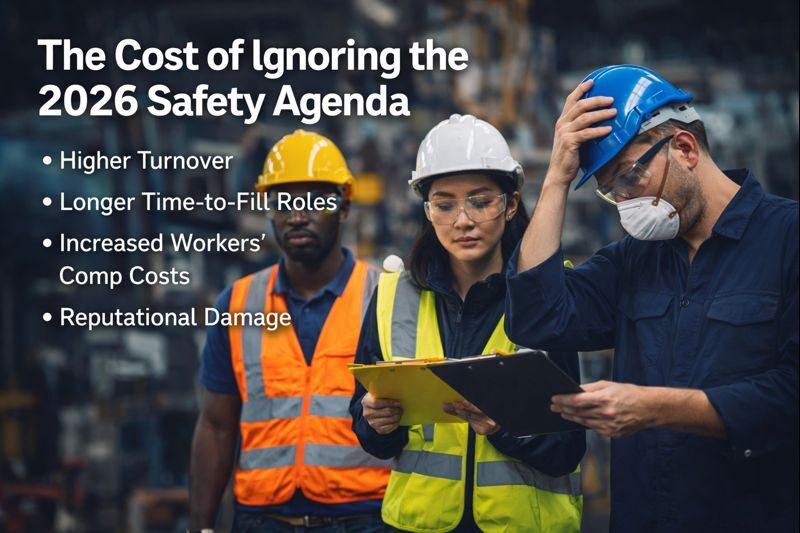
The Cost of Ignoring the 2026 Safety Agenda
Organizations that fail to address heat, violence, and safety culture face compounding consequences:
- Higher turnover
- Longer time-to-fill roles
- Increased workers’ compensation costs
- Executive attrition
- Reputational damage in tight labor markets
Most dangerously, they create leadership gaps because the people best equipped to lead leave first.
What Forward-Thinking Leaders Are Doing Now
Across manufacturing and industrial sectors, leaders who are winning talent in 2026 are:
- Integrating safety into employer branding conversations
- Training managers to speak confidently about risk management
- Auditing safety culture, not just compliance
- Elevating EHS leaders into strategic roles
- Treating safety incidents as leadership failures not paperwork issues
This approach signals maturity, credibility, and trustworthiness.
Why Safety Strategy Is Now a Board-Level Talent Issue
Boards are beginning to understand what frontline leaders already know:
- Safety failures lead to leadership failures
- Leadership failures lead to turnover
- Turnover threatens continuity and growth
In executive search conversations, safety culture is increasingly viewed as a predictor of leadership success.
Companies that ignore this reality will struggle to attract the next generation of plant leaders, operations executives, and functional heads.
Final Thought: In 2026, Safety Is the Signal
In a labor market shaped by scarcity, transparency, and accountability, safety has become a signal of leadership quality.
The organizations that thrive will not be those with the most polished messaging but those whose actions match what talent now demands:
- Protection
- Preparation
- Respect
In 2026, the strongest employer brands won’t just say “We care about safety.”
They’ll be known for proving it.